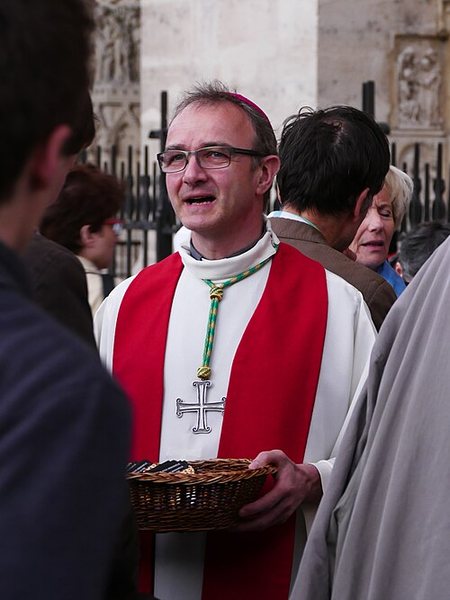

Field file 011
Abp Thibault Verny
Thibault Verny
IN OFFICE · NEW STATUTES JUNE 2026
4 of The Helm in The Roman Catholic Church
Opened 2026-07-26 · verified 2026-07-26
A field file on a person in a public role, from the public record. Private lines (family, health, home, security, personal wealth) are kept at home and not shown.
I · Identity
- Full legal name
- Thibault Verny. A French diocesan priest — not a cardinal, and the second card in this suit without a red hat.
- Name in office
- President of the Pontifical Commission for the Protection of Minors, while remaining Archbishop of Chambéry and Bishop of Maurienne and Tarentaise.
- The distinction ★
- He holds the hardest brief in the Catholic Church. The Commission exists because of the abuse crisis, and its credibility is the Church's credibility. A French lawyer working on abuse called him “a pioneer in his field” — which is the kind of endorsement this office needs and rarely gets.
- Date of birth
- 7 November 1965 — age 60.
- Place of birth
- Paris, France.
- Nationality
- French. The only Frenchman in this suit.
- Languages partial
- French, and working Italian for Roman business. No verified list found.
II · The Likeness & the Ground
- Places of operation
- Four pins and all of them European. Paris, Chambéry, Kraków, Rome. The map's honest limitation is the file's honest limitation: he leads a commission whose subject is worldwide, and his own experience is one country's reckoning with it. Whether French lessons transfer to the Church in Africa, Asia and Latin America is the open question of his presidency.
- Paris1965–2023
Born 7 November 1965. Ordained priest 27 June 1998, aged 32 — late, by the standards of this suit. Auxiliary Bishop of Paris 2016–2023, where he first took on abuse work. - Chambéry2023– · his see
Archbishop of Chambéry and Bishop of Maurienne and Tarentaise from 11 May 2023 — an Alpine archdiocese in Savoie. He still runs it. - KrakówSep–Oct 2025
The Commission's plenary assembly, 29 September to 3 October 2025, ahead of its second annual report. - Vatican City2025– · the Commission
President of the Pontifical Commission for the Protection of Minors from July 2025, succeeding Cardinal Seán O'Malley.
- Paris1965–2023
III · The Office
- Exact title
- President of the Pontifical Commission for the Protection of Minors — the Holy See body charged with safeguarding policy and with holding the Church to its own standards.
- Held since
- July 2025, appointed by Pope Leo XIV — one of the earliest significant appointments of the pontificate.
- Whom he replaced ★
- Cardinal Seán Patrick O'Malley, OFM Cap., the retired Archbishop of Boston and the Commission's founding president, who issued a statement welcoming the nomination.
- The new statutes ★
- June 2026 — Leo XIV approved new Statutes, replacing those of 2015, and granted a renewed mandate. Crucially they are approved ad experimentum for three years. The Commission is on trial, and the pope said so in the paperwork.
- What the Commission does
- Advises the pope on safeguarding, works with bishops' conferences, and — since 2024 — publishes an annual report on how the Church is actually performing. The report is the instrument; everything else is advice.
- How he got it
- Appointed by the pope, on the strength of a decade of French abuse work rather than a Roman career. He is not a Curia man.
- The dual role
- He still governs an archdiocese. Unlike the full-time officials elsewhere in this suit, Verny runs Chambéry and the Commission at once — which is either a sign of the Commission's modest weight or of his own capacity.
- Who can remove him
- Leo XIV, at will. The three-year statutes give the pope a natural review point in 2029.
IV · The Power
- Scope
- The whole Church, in principle. Safeguarding touches every diocese, every religious order, every school and parish on earth.
- Hard power
- Almost none, and this is the structural criticism of the office. The Commission advises. It does not judge, discipline or remove — those powers sit with the Dicastery for the Doctrine of the Faith and with the pope.
- Soft power
- Publication. The annual report is the one thing this office does that a bishop cannot ignore, because it puts performance on paper where the press can read it.
- The annual report ★
- The second was published 16 October 2025, after the Kraków assembly. The third is reported to focus on reparations — money and redress for victims, which is the subject dioceses fight hardest.
- Recent work ★
- 15–16 June 2026 — Verny opened the Commission's first in-person meeting with Ending Clergy Abuse, a survivors' organisation, reaffirming the duty to listen to victims and survivors. Meeting campaigners in the room rather than in a statement is new.
- The pope's attention
- 16 March 2026 — Leo XIV addressed the Commission's members directly, a speech published on vatican.va. Three months later he rewrote its statutes.
- Chain of command
- Answers to Leo XIV (A♠). The Commission sits alongside, not inside, the doctrinal machinery that actually tries abuse cases — see A♦ Fernández.
- Budget unverified
- UNVERIFIED. The Commission's budget and staffing could not be confirmed on 26 July 2026.
V · Formation
- Education unverified
- UNVERIFIED in detail. Seminary formation in Paris; specific degrees were not confirmed in this check.
- Ordination
- Ordained priest 27 June 1998, aged 32. The latest ordination in this suit — most of these men were ordained in their mid-twenties, and several entered seminary as children.
- Auxiliary of Paris
- 2016–2023. Seven years as a bishop in the French capital, and where the abuse work began.
- The French reckoning ★
- President of the Council for the Prevention of and Fight against Paedophilia within the French Bishops' Conference, until June 2024. He led the French Church's response through the period of its national reckoning — a reckoning far more public and more brutal than most countries have had.
- Archbishop of Chambéry
- 11 May 2023 — appointed to the Alpine see he still holds, with the joined dioceses of Maurienne and Tarentaise.
- The climb
- 27 Jun 1998 ordained priest, Paris · 2016 Auxiliary Bishop of Paris · abuse lead for the French Bishops' Conference · 11 May 2023 Archbishop of Chambéry · to Jun 2024 president of the French anti-abuse council · Jul 2025 President of the Pontifical Commission for the Protection of Minors.
VI · The Ties
- Known associates ★
- His predecessor: Cardinal Seán Patrick O'Malley, OFM Cap., founding president of the Commission, who publicly welcomed his nomination.Who appointed him: Leo XIV (A♠) — in July 2025, then rewrote his statutes in June 2026.Across the table: Ending Clergy Abuse, the survivors' network he met in person in June 2026.The French Bishops' Conference, whose anti-abuse council he led to June 2024.Institutionally adjacent: Cardinal Víctor Manuel Fernández (A♦) at the Doctrine of the Faith, which actually tries abuse cases — Verny advises, Fernández judges.The uncomfortable neighbour in this suit: Cardinal Kevin Farrell (J♠), whose own account of what he did not see in Washington and among the Legionaries is the kind of question Verny's Commission exists to press.
- Timeline
- 7 Nov 1965 born, Paris · 27 Jun 1998 ordained priest · 2016–2023 Auxiliary Bishop of Paris · president, French Bishops' Conference council on paedophilia, to Jun 2024 · 11 May 2023 Archbishop of Chambéry · Jul 2025 appointed President of the Pontifical Commission for the Protection of Minors, succeeding O'Malley · 29 Sep–3 Oct 2025 Commission assembly, Kraków · 16 Oct 2025 second annual report · 16 Mar 2026 Leo XIV addresses the Commission · 15–16 Jun 2026 first in-person meeting with Ending Clergy Abuse · Jun 2026 new statutes approved ad experimentum for three years.
- His own channels
- The Commission publishes at tutelaminorum.va — the annual reports are there in full, and they are the most useful primary source in this file. Leo's March 2026 address to the Commission is on vatican.va.
VII · Doctrine & Position
- School
- Practitioner, not theorist. His formation on this subject is casework: listening to victims, and dealing with civil and judicial authorities rather than only with canon law.
- THE MACHINE QUESTION ★
- Answered — and from an angle nobody else in this suit takes. The Commission has named two areas for deepened study, and one of them is the prevention of technology-facilitated abuse of minors in the digital space. This is the only card in The Helm treating the machine as a present danger to actual children rather than as a philosophical question about persons. Not the soul; the safeguarding of a child from a screen.
- IN TECH NOW ★
- The only Roman office treating the machine as a present harm. His Commission has named the prevention of technology-facilitated abuse of minors in the digital space as one of two areas for deepened study — AI as a danger to actual children this year, not a question about personhood.
- Where his weight falls ★
- On the practical end of the machine question. Leo argues about human dignity, Gallagher about autonomous weapons, Reina about algorithms and survival. Verny is the only one asking what the technology is doing to children this year — which is also 7♣ in The Contenders, the child-safety movement, the argument that crosses every political line and moves fastest into law.
- On vulnerability
- The Commission's other deepening study is the concept of vulnerability in relation to abuse — extending safeguarding beyond minors to adults who cannot protect themselves. A quiet but very large expansion of what the Church says it owes people.
- Signature posture
- Listening. Reported consistently as dedicated to listening to and accompanying victims, and to working with civil and judicial authorities rather than around them — which in the history of this crisis is the whole argument.
- Published works
- UNVERIFIED as a personal bibliography. His output is the Commission's institutional reporting.
- What he has changed his mind about unverified
- UNVERIFIED. Nothing on record.
VIII · The Sword & the State
- The civil authorities
- The defining feature of his record. He is described as working through necessary interaction with civil and judicial authorities — the precise thing the Church spent decades avoiding, and the reason a French bishop rather than a Curial official got this job.
- France
- He led the bishops' anti-abuse council through the years of the French Church's public reckoning — a national reconciliation conducted largely in the press and the courts.
- The survivors' movement
- Ending Clergy Abuse is an international campaigning network, not a Church body. Sitting down with them in Rome in June 2026 was a decision, not a formality.
- Poland
- The Kraków assembly of autumn 2025 — the Commission meeting in a country with its own unresolved abuse history rather than in Rome.
IX · Conflict & Controversy
- The Commission's own history ★
- The controversy he inherited. The body has been criticised throughout its existence for lacking teeth, and prominent survivor-members have resigned from it in the past over exactly that. Specific past resignations were not re-verified for this file. Leo's three-year ad experimentum statutes are a tacit acknowledgement that the question is still open.
- Advice without power
- The structural objection: a commission that can recommend but not compel sits inside an institution where only the pope and the doctrinal dicastery can act. Critics call it a shield; defenders call it the only workable design.
- Scandals
- None found. No scandal, accusation or proceeding against him personally surfaced in this check. Recorded as a negative finding, not an absence of looking.
- The reparations report partial
- The forthcoming third report's focus on reparations puts him on a collision course with dioceses and orders over money. The most likely source of open conflict in the next year.
X · The Standing
- Immunity & legal shield unverified
- UNVERIFIED. A French citizen and diocesan bishop, subject to French law in his own see; no specific determination checked.
XI · The File
- Why the Four
- Because he advises and publishes but cannot compel, and his own see is a small Alpine archdiocese. On raw institutional power this is a low card. On consequence it may be the most important in the suit — every other office here depends on the Church retaining enough moral standing to be listened to, and that standing is this man's brief.
- Cross-references
- Dossier II · A♠ Leo XIV, who appointed him and rewrote his statutes · J♠ Farrell, whose own record is the kind of question this office exists to ask · A♦ Fernández at Doctrine, who tries the cases Verny can only report on · The Contenders 7♣, the child-safety movement.
- The one thing to know ★
- He is the only man in this suit whose subject is children rather than power — and the only one treating artificial intelligence as something already hurting people. While the rest of The Helm argues about souls, autonomous weapons and algorithms in nuclear systems, Thibault Verny's Commission is studying technology-facilitated abuse of minors in the digital space. His office cannot compel anyone to do anything. It can only write down what is true and publish it once a year — and Leo XIV has given it three years to prove that is enough.
XII · The Timeline
- 2022 · commission membership
- Joined the Pontifical Commission for the Protection of Minors, according to his predecessor's appointment statement. Timeline checked 2026-09-23. Primary source. Other sections retain their original verification dates.
- 5 July 2025 · presidency
- His appointment as commission president was welcomed in an official statement by outgoing president Seán O'Malley.
- 2025 · experience identified at appointment
- The statement describes prior work with survivors, law enforcement, civil authorities, and Church leadership in France. It is an institutional account of his experience, not an independent evaluation of outcomes.
XIII · The House Reading
- Place in the landscape
- Verny's subject is safeguarding and institutional accountability. His commission's advice and reporting must be distinguished from the powers of civil authorities or bodies that adjudicate individual cases. House analysis written 2026-09-23; these applications are inferences, not the subject's statements about this house.
- What could help this house
- Make it possible for a child or adult to raise a concern outside the person who leads the house. A written commitment to care needs an accessible reporting route and a clear response when the concern involves a leader.
- What could hurt this house
- An impressive safeguarding title can create reassurance without a working route to protection. Test who receives a concern, who can act, and whether a person can seek outside help without retaliation.
- Boundary and next evidence
- The appointment statement is evidence of a mandate and its authors' assessment, not proof that every safeguarding problem is solved. Look for implemented procedures and independent scrutiny before treating an institution as a finished model.
Sources
- Holy See Press Office — Statement from Cardinal Seán Patrick O'Malley on the nomination of Abp Thibault Verny (5 July 2025)
- Vatican News — Pope names French bishop Thibault Verny as new president of the Pontifical Commission (July 2025)
- Vatican News — Protection of Minors Commission receives new Statutes, renewed mandate (June 2026)
- Vatican.va — Leo XIV, To Members of the Pontifical Commission for the Protection of Minors (16 March 2026)
- Tutela Minorum — Pontifical Commission for the Protection of Minors and Ending Clergy Abuse (June 2026 meeting)
- National Catholic Reporter — Commission will focus its new report on reparations
- National Catholic Reporter — New president 'pioneer in his field,' French lawyer says
- Angelus News — Vatican updates child protection commission statutes
- Wikipedia — Thibault Verny
- Wikimedia Commons — portrait, Peter Potrowl, CC BY-SA 4.0
- Wikimedia Commons — BlankMap-Equirectangular.svg, CC0 (base map)
- Timeline primary source checked 2026-09-23; house applications are editorial analysis

