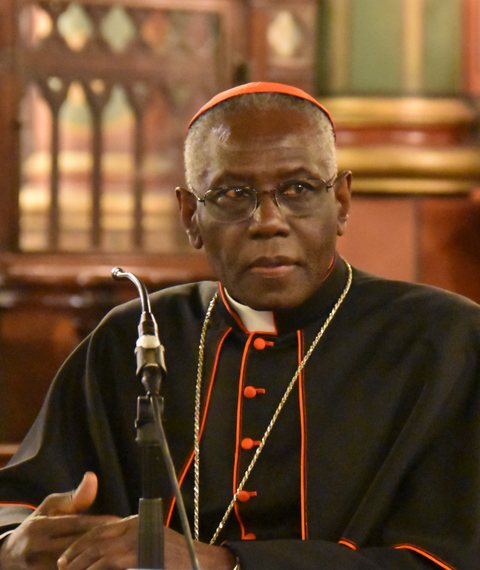

Field file 043
Cardinal Robert Sarah
Robert Sarah
RETIRED · AGE 81 · NON-ELECTOR · STILL THE LOUDEST VOICE OF THE OLD GUARD
6 of Orders & Voices in The Roman Catholic Church
Opened 2026-09-04 · verified 2026-09-04
A field file on a person in a public role, from the public record. Private lines (family, health, home, security, personal wealth) are kept at home and not shown.
I · Identity
- Full legal name
- Robert Sarah. “Sarah” is the family name; “Robert” the baptismal name given within his family's own conversion to Christianity. No separate clan or birth-register name distinct from this was found.
- Name in office
- Cardinal Robert Sarah — Prefect Emeritus of the Dicastery (formerly Congregation) for Divine Worship and the Discipline of the Sacraments, and Archbishop Emeritus of Conakry. Style: His Eminence, the ordinary cardinalatial address.
- The distinction ★
- He is the only cardinal in this deck the Vatican's own record shows was scheduled to be assassinated. As Archbishop of Conakry he was placed on President Sékou Touré's death list; the killing was set for April 1984, and Touré himself died of heart failure the month before. No other figure in this hall owes his survival so directly to a dictator's own death beating the dictator's plan for him.
- Date of birth
- 15 June 1945 — age 81, as of this file.
- Place of birth
- Ourouss, a Coniagui farming village now in Koundara Prefecture, Boké Region, northern Guinea, on the Senegalese border.
- Nationality ★
- Guinean. Resident in Rome since 2001, which under Vatican law makes him also a Vatican City State citizen ex officio — a citizenship every cardinal resident there holds automatically, and loses automatically the day he stops being resident.
- Languages partial
- French as his working and colonial-inherited language, plus English, Spanish and Italian, reported consistently across biographical sources. No authoritative single list was found, and no assessment of any Coniagui-language fluency was verified.
II · The Likeness & the Ground
- Places of operation
- Five pins, four countries, one man moved by other people's politics at every stage. Guinea twice — the village that made him and the see that nearly cost him his life — bridged by a seminary in Ivory Coast and a forced detour through Senegal after Guinea's own government shut down church schooling. Then Rome, where he has now lived a quarter of a century — longer than he was ever Archbishop of Conakry.
- Ourouss, Guinea1945 — born
Born 15 June 1945 in Ourouss, a Coniagui farming village now in Koundara Prefecture, Boké Region, hard against the Senegalese border. His parents were cultivators and converts from the traditional religion of the Coniagui people. - Bingerville, Côte d'Ivoire1957 — minor seminary
Entered Saint Augustine Minor Seminary at age twelve. Guinea's own government would shut his path home to study four years later — the first of several times politics, not aptitude, redrew his education. - Sébikotane, Senegal1967–1969 — seminary completed
Continued his formation here after Guinea's regime expropriated church property in 1961 and later expelled the European missionary clergy outright, in a campaign officially aimed at forcing the Africanisation of the Guinean clergy onto the state's own terms. A parallel stretch at the Grand Seminary of Nancy, France (1964–66) was also interrupted. - Conakry, Guinea1979–2001 — Archbishop
Appointed Archbishop of Conakry on 13 August 1979, consecrated that 8 December at thirty-four — the youngest Catholic bishop in the world at the time. Placed on President Ahmed Sékou Touré's death list; the assassination was scheduled for April 1984, and Touré died of heart failure the previous month. - Rome2001– · the whole Vatican career
Secretary for Evangelisation of Peoples 2001 · President of Cor Unum 2010 · Cardinal 20 Nov 2010 (San Giovanni Bosco in Via Tuscolana) · Prefect of Divine Worship 2014–2021 · elevated Cardinal-Priest 2021. Twenty-five years in Rome — longer than he was ever Archbishop of Conakry.
- Ourouss, Guinea1945 — born
III · The Office
- Exact title
- Prefect Emeritus of the Dicastery for Divine Worship and the Discipline of the Sacraments and Archbishop Emeritus of Conakry. As a cardinal he also holds the title Cardinal-Priest of San Giovanni Bosco in Via Tuscolana, Rome.
- Held since / until
- Appointed Prefect of Divine Worship on 23 November 2014 by Pope Francis, succeeding Cardinal Antonio Cañizares Llovera. Retired 20 February 2021, on turning 75 — the ordinary canonical retirement age for a curial head.
- What the office did
- Governed the Latin Church's public liturgy worldwide — missal translations, sacramental discipline, liturgical law. Sarah used it to argue, unsuccessfully in the end, for practices such as Mass celebrated ad orientem; Pope Francis clarified in July 2016 that facing the congregation remained the norm.
- The successor who reversed him ★
- Archbishop Arthur Roche (10♦ in this deck) took the office in May 2021 — and went on to enforce Traditionis Custodes, Pope Francis's 2021 restriction of the old Latin Mass. The man who now runs Sarah's old department is the one carrying out the policy Sarah spent August 2026 publicly calling a “war” on the faithful.
- Whom he replaced at Conakry
- Archbishop Raymond-Marie Tchidimbo, who had been imprisoned by Sékou Touré's regime for eight years at Camp Boiro, was released 7 August 1979 as part of a Holy See–Guinea deal, and resigned the see five days later. Sarah was named his successor that same week, at thirty-four.
- Who can remove him now
- In the ordinary course, no one. Cardinal rank is for life; only the pope could strip it, for grave cause, and that has essentially no modern precedent for a case like his. Retirement ended his offices, not his hat.
- Current dicastery memberships partial
- Unresolved between sources. One tracker lists him as a current member of the dicasteries for Oriental Churches, Causes of Saints, Evangelisation and Divine Worship; another shows no active membership at all following his 2021 retirement. Neither was cross-checked against a live Vatican Annuario entry for this file.
- Where he sits
- Rome, resident there since 2001. His titular church, San Giovanni Bosco in Via Tuscolana, is where his cardinalatial rank is formally anchored.
IV · The Power
- Scope
- Formerly the Archdiocese of Conakry — Catholics are a small minority in a country roughly 85% Muslim — for twenty-two years, then the Latin Church's entire public liturgy for six more. Today: no formal jurisdiction over anyone.
- Hard power
- None. Every governing post he ever held is now held by someone else. No budget, no subordinates, and — on the conflicting evidence above — quite possibly no active dicastery seat left at all.
- Soft power ★
- Considerable, and apparently undiminished by retirement. Seven books since 2015, a standing invitation from the traditionalist press, a July 2026 platform at the European Parliament, and — as of September 2026 — the capacity to still set a week of Catholic news from a single newspaper interview.
- What he no longer holds
- Every office he is best known for. Not Archbishop of Conakry — that see has passed twice since him, to Vincent Coulibaly (2001–2026) and, from 28 February 2026, to Archbishop François Sylla. Not Prefect of Divine Worship — that passed to Arthur Roche (10♦), the man now enforcing the restriction Sarah opposes.
- The one real lever ★
- His own voice, on a schedule no office constrains. The 27 August 2026 Il Giornale interview and the public rebuke it drew from a papal biographer four days later show a retired 81-year-old still able to dominate a Catholic news cycle without holding a single title that requires anyone to listen.
- Chain of command
- He answers to the pope, and only in the residual sense every cardinal does. Pope Leo XIV has not censured him for the August 2026 remarks; the same pope had, weeks earlier, named him his own special envoy to France for the 400th anniversary of the apparitions of St Anne — trust extended even as the friction continued elsewhere.
- Budget unverified
- UNVERIFIED. No figure was found for any personal stipend, pension, or discretionary funds available to him as a retired cardinal.
- Staff unverified
- UNVERIFIED. No confirmed personal staff, secretariat, or household size was found for this file.
V · Formation
- The call
- Began frequenting Spiritan (Holy Ghost Fathers) missionary stations from around age twelve, where — by his own later account — he found his vocation, and entered Saint Augustine Minor Seminary, Bingerville, Ivory Coast in 1957.
- The interruption
- In 1961 Guinea's post-independence government under Ahmed Sékou Touré expropriated Church property, disrupting his studies; a stretch at the Grand Seminary of Nancy, France (1964–1966) was also cut short. He completed formation at Sébikotane, Senegal, in the years the regime went on to expel the European missionary clergy outright (1967), in a campaign the historical record frames as forcing an “Africanisation” of the Guinean clergy under state control rather than the Church's own.
- Ordination and a narrow escape ★
- Ordained priest 20 July 1969 in Conakry by Archbishop Raymond-Marie Tchidimbo — the man he would later succeed. Tchidimbo was arrested that December, tortured, and given a life sentence; released after eight years at Camp Boiro on 7 August 1979 and flown to Rome, he resigned Conakry five days later. Sarah, ordained bishop by Archbishop Giovanni Benelli on 8 December 1979, became Archbishop of Conakry at thirty-four — the youngest Catholic bishop in the world.
- The death list ★
- As archbishop he clashed openly with Touré's government. He was placed on a list of people the dictator intended to have killed; the killing was scheduled for April 1984. Touré died of heart failure after emergency surgery in March 1984, weeks before the plan could be carried out.
- Education
- Licentiate in Theology and in Sacred Scripture, Pontifical Gregorian University, Rome (1969–1974), with a year (1971) at the Studium Biblicum Franciscanum, Jerusalem.
- The cardinalate
- Created Cardinal-Deacon of San Giovanni Bosco in Via Tuscolana on 20 November 2010 by Benedict XVI. Elevated pro hac vice to Cardinal-Priest of the same title on 3 May 2021 — the standard promotion after ten years as a cardinal-deacon.
- The climb
- 1945 born, Ourouss · 1957 minor seminary, Bingerville · 1961 Guinea seizes Church property, studies disrupted · 1964–69 Nancy, then Sébikotane · 1969 ordained priest, Conakry · 1969–74 Rome and Jerusalem · 13 Aug / 8 Dec 1979 Archbishop of Conakry, age 34 · Mar–Apr 1984 survives Touré's death list by the dictator's own death · 2001 Secretary, Evangelisation of Peoples, Rome · 2010 President of Cor Unum, then Cardinal · 2014 Prefect of Divine Worship · Aug 2023 co-signs the second dubia on the Synod on Synodality · 2021 retires as Prefect, elevated Cardinal-Priest, undergoes robot-assisted surgery · 2024 Pope Francis calls him “bitter” in a memoir · Jan 2024 calls Fiducia Supplicans heretical · 2025 votes in the conclave that elects Leo XIV, days before turning 80 · 2026 appeals to the SSPX, addresses the European Parliament, is named papal envoy to France, and picks a public fight over the Latin Mass.
VI · The Ties
- Known associates ★
- The predecessor he replaced, and who ordained him: Archbishop Raymond-Marie Tchidimbo, released from eight years' imprisonment days before resigning Conakry to him.The man who consecrated him bishop: Archbishop Giovanni Benelli.His 2023 dubia co-signers: Cardinals Walter Brandmüller, Raymond Burke, Joseph Zen Ze-kiun and Juan Sandoval Íñiguez.His closest doctrinal ally in this deck: Cardinal Gerhard Müller (5♣), the card immediately below his own, whom the deck itself calls the Church's most prominent conservative critic.His accuser from the right: Archbishop Carlo Maria Viganò, who in 2026 branded Müller, Sarah and Burke a “controlled opposition.”His disputed co-author: Pope Benedict XVI (d. 2022), via the 2020 celibacy book — with Benedict's secretary Archbishop Georg Gänswein on the other side of that dispute.The pope who called him “bitter”: Pope Francis, in his 2024 memoir The Successor.His direct successor at Divine Worship: Cardinal Arthur Roche (10♦), now enforcing the restriction Sarah publicly opposes.His successors at Conakry: Vincent Coulibaly (2001–2026), then Archbishop François Sylla from February 2026.Above him now: Pope Leo XIV (A♠), who named him special envoy to France in 2026 despite the friction elsewhere.
- Timeline
- 15 Jun 1945 born, Ourouss · 1957 Bingerville minor seminary · 1961 Guinea seizes Church property · 1969 ordained priest, Conakry · 1969–74 Rome, Jerusalem · 13 Aug 1979 named Archbishop of Conakry · 8 Dec 1979 consecrated, age 34 · Mar 1984 Touré dies before the planned assassination · 1985–2001 president, Guinean Episcopal Conference · 1 Oct 2001 Secretary, Evangelisation of Peoples, Rome · 7 Oct 2010 President, Cor Unum · 20 Nov 2010 created Cardinal · 23 Nov 2014 Prefect, Divine Worship · Oct 2016 ad orientem row with Francis · 21 Aug 2023 co-signs second dubia, Synod on Synodality · 20 Feb 2021 retires as Prefect · 3 May 2021 elevated Cardinal-Priest · 12–27 Jul 2021 robot-assisted prostate surgery · 8 Jan 2024 calls Fiducia Supplicans heretical · Apr 2024 Francis's memoir calls him “bitter” · May 2025 votes in the conclave; Leo XIV elected · 15 Jun 2025 turns 80, loses conclave vote · 22 Feb 2026 appeals to the SSPX over its planned consecrations · 28 Feb 2026 Conakry passes to Abp Sylla · 4 Mar 2026 publishes 2050 with Nicolas Diat · 1 Jul 2026 SSPX consecrates bishops anyway; automatic excommunications follow · 15 Jul 2026 addresses the European Parliament, Brussels · 19 Jul 2026 named papal envoy to Sainte-Anne-d'Auray · 25–26 Jul 2026 presides at the 400th-anniversary celebrations · 27 Aug 2026 Il Giornale interview against Traditionis Custodes · 1 Sep 2026 Austen Ivereigh publicly calls his language “incendiary.”
- His own channels partial
- No personal website or verified social-media account found. His voice reaches the public almost entirely through book-length interviews — most often with the French journalist Nicolas Diat — published by Ignatius Press in English and Fayard/Cantagalli in French and Italian, and through the traditionalist press (Rorate Cæli, Il Giornale, Tribune Chrétienne).
VII · Doctrine & Position
- School
- Liturgical traditionalist, in the Ratzingerian “reform of the reform” mould. Formed a working alliance with Benedict XVI's circle, favours ad orientem celebration and continuity with the old rite, and reads the post-conciliar liturgical reforms as having gone further than Vatican II itself required.
- THE MACHINE QUESTION partial
- No personal position on record. He has invoked Pope Leo XIV's AI encyclical Magnifica Humanitas exactly once found in this check — at the European Parliament on 15 July 2026 — and even there he redirected its warning about manipulative and deceptive language away from artificial intelligence itself and onto international diplomacy and gender terminology. He has not, on any record found, addressed whether a machine could think, know, or possess a soul.
- IN TECH NOW partial
- He borrows the pope's encyclical for a different argument, and otherwise keeps his distance from the subject. At Brussels on 15 July 2026 he cited Magnifica Humanitas's critique of manipulative language to attack ideological terminology in Europe–Africa relations — not to comment on AI as such. His only personal encounter with advanced technology on record is medical: robot-assisted (da Vinci) prostate surgery in July 2021. His signature theme remains noise, not machines — see “Signature posture” below.
- Fiducia Supplicans ★
- “We firmly and radically oppose a heresy.” In his first full public statement on the December 2023 declaration permitting blessings for same-sex couples, given in early January 2024, he said it was contrary to Catholic faith and Tradition and gravely damaging to the Church — while insisting “we do not oppose Pope Francis.” He encouraged bishops' conferences worldwide to join the refusal.
- Signature posture
- Silence against noise. His best-known book, The Power of Silence: Against the Dictatorship of Noise (2017), argues modern life's constant noise crowds out God: “If our 'interior cell phone' is always busy because we are 'having a conversation' with other creatures, how can the Creator reach us?” It is a critique of modern distraction generally, not of any specific technology or of AI.
- Published works
- God or Nothing (2015) · The Power of Silence (2017) · The Day is Now Far Spent (2019) · From the Depths of Our Hearts, with Benedict XVI (2020) · Pour l'éternité / For Eternity (2021) · Catechism of the Spiritual Life (2022) · 2050, with Nicolas Diat (March 2026). Seven interview-format books in eleven years — the output of a man with no office left but a great deal still to say.
- Where his weight actually falls
- On liturgy and doctrine, not diplomacy or governance. Contrast Cardinal Pietro Parolin (K♠), whose file in this deck is built entirely around statecraft: Sarah has run no negotiation and signed no treaty. His currency was always the missal and the pulpit, and retirement has not changed that.
- What he has never walked back
- Decades of remarks that draw fresh criticism whenever they resurface — dismissing a 2012 UN appeal on anti-homosexuality laws as “stupid”, comparing Western “homosexual and abortion ideologies” to Nazism and Communism at the 2014–15 Synod, and attributing the abuse crisis chiefly to “the absence of God” rather than institutional failure. None has been retracted. The only public correction on record — the 2020 celibacy-book byline — was forced by Benedict's own circle, not volunteered by him. See Section IX for the incidents themselves.
VIII · The Sword & the State
- State standing
- None in his own right beyond the Vatican City State citizenship automatic to a resident cardinal (see Identity). He heads no government department and negotiates no treaties.
- Guinea partial
- His home country's Church-state history is his own: opposition to Sékou Touré's dictatorship up to the death-list years, then decades governed from Conakry until 2001. Present-day Guinea has moved from Mamady Doumbouya's 2021 coup to his inauguration as elected civilian president on 17 January 2026, amid opposition claims the government still rules through fear. No recent Sarah comment on the Doumbouya government was found in this check — a retired cardinal in Rome, seemingly, staying out of it.
- France
- Named Pope Leo XIV's special envoy for the 400th anniversary of the apparitions of St Anne, presiding at Sainte-Anne-d'Auray, 25–26 July 2026 — a genuine Vatican–French ceremonial assignment, and evidence the current pope still hands him real, if symbolic, work.
- The European Parliament
- Addressed MEPs in Brussels on 15 July 2026, warning of a “crisis of the logos” in which language is used to “hide reality” rather than reveal it, and naming terms such as “sexual and reproductive health” and “gender equality” as vehicles for what he called the ideological colonisation of Africa by Europe.
IX · Conflict & Controversy
- The Benedict XVI book dispute ★
- In January 2020 From the Depths of Our Hearts, defending priestly celibacy, appeared co-signed by Benedict XVI and Sarah. Benedict's secretary, Archbishop Georg Gänswein, disputed how much the retired pope had actually reviewed; Sarah maintained Benedict had approved the full text. The byline was changed to credit Benedict only as a contributor. Pope Francis was reportedly displeased with how the episode was handled and later moved Gänswein out of his post.
- Francis's verdict ★
- In his 2024 memoir The Successor, Pope Francis called Sarah “a good, austere, and prayerful man” but added “I sometimes feel his work in the Curia left him a little bitter” — and said that during his time running Divine Worship, Sarah was “immediately manipulated by separatist groups.”
- "Controlled opposition" ★
- In 2026 Archbishop Carlo Maria Viganò — himself excommunicated for schism in 2024 — accused Müller, Sarah and Burke of functioning as a “controlled opposition”, arguing that all three had accepted Cardinal Fernández's authority, never demanded the revocation of Fiducia Supplicans, and never blocked Traditionis Custodes despite their public complaints. The most senior conservative critics of Rome are themselves accused, from further right, of not being critical enough.
- The remarks that keep resurfacing
- Calling a 2012 UN appeal against anti-homosexuality laws “stupid”; comparing Western “homosexual and abortion ideologies” to Nazi-Fascism and Communism at the 2014–15 Synod on the Family; and attributing the sexual-abuse crisis chiefly to “the absence of God” rather than institutional failure. Recorded here without editorial softening — the house rule is that a file states what was said.
X · The Standing
- Immunity & legal shield partial
- Holds Vatican City State citizenship as a resident cardinal, which carries some functional standing under the Holy See's own arrangements. The precise legal protections this affords under Italian or international law were not verified for this file.
XI · The File
- Why the Six
- Because his currency now is entirely rhetorical. A Six sits low in a suit built around heads of religious orders and leading living voices — real influence, but no institutional command behind it. He commands no order, no dicastery, no diocese; he commands attention, and as of September 2026 he can still get it.
- Cross-references
- Dossier II · 10♦ Arthur Roche, his direct successor at Divine Worship, now enforcing the restriction Sarah calls a “war” on the faithful · 5♣ Gerhard Müller, his dubia ally and likely heir to the traditionalist mantle · K♠ Pietro Parolin, the diplomat-cardinal his own file is deliberately not · A♠ Leo XIV, who still hands him real assignments despite the public friction.
- The one thing to know ★
- A dictator scheduled his death and died first. Robert Sarah became the youngest bishop on earth at thirty-four, in a country that had already imprisoned his predecessor for eight years and would soon put Sarah himself on a kill list — and outlived the man who wrote it by four decades and counting. He ran the Vatican's entire public liturgy for six years, lost the argument on the Latin Mass to Pope Francis, retired at 75 — and then, at 81, picked the same fight up again in a newspaper interview and got a papal biographer to call him bitter and attention-seeking in public, four days before this file closed. He has no office left. He has not run out of things to say.
XII · The Timeline
- 1969 · priesthood
- Ordained in Conakry on 20 July. Timeline checked 2026-09-23. Primary source. Other sections retain their original verification dates.
- 1979 · Conakry
- Appointed archbishop on 13 August and consecrated on 8 December, aged 34.
- 2001–2010 · Vatican service
- Became secretary for the Evangelization of Peoples in 2001 and president of Cor Unum in 2010; created cardinal that November.
- 2014–2021 · liturgical government
- Appointed prefect of Divine Worship on 23 November 2014. His tenure ended on 20 February 2021; the official biography identifies him as prefect emeritus.
XIII · The House Reading
- Place in the landscape
- Sarah is a former diocesan and Vatican executive. His emeritus status matters: earlier authority over liturgy must not be reported as a current power to issue orders. House analysis written 2026-09-23; these applications are inferences, not the subject's statements about this house.
- What could help this house
- Use his career to separate the value of a stable rite from the authority of its most prominent advocate. A repeated order of worship can be taught and preserved without turning one speaker into its owner.
- What could hurt this house
- A retired leader can still attract loyalty. If the house treats personal prestige as a second government, a formal handover may fail even after every document is signed.
- Boundary and next evidence
- The risk described is a succession problem to test in this house, not an allegation against Sarah. Compare his own dated statements with decisions made by the current officeholder before describing a dispute or choosing what to adopt.
Sources
- Wikipedia — Robert Sarah (biography, career, controversies, bibliography)
- Holy See Press Office — official biography, Card. Robert Sarah
- Catholic-Hierarchy — Robert Cardinal Sarah (offices and dates)
- Wikipedia — Ourouss (birthplace, coordinates, administrative location)
- Qui est qui en Guinée — Biography of Robert Sarah (early life, seminary interruptions, ethnic background)
- Catholic Answers Magazine — Robert Sarah: The Best-Kept Papabile Secret (youngest bishop, death list)
- Wikipedia — Raymond-Marie Tchidimbo (imprisonment, release, succession by Sarah)
- Catholic News Agency — Cardinal Sarah undergoes robot-assisted surgery (July 2021)
- America Magazine — Pope appoints Cardinal Robert Sarah as Prefect of the Congregation for Divine Worship (2014)
- America Magazine — Pope Francis appoints Archbishop Roche as new prefect of Divine Worship, successor to Cardinal Sarah (2021)
- aciafrica.org — "We firmly and radically oppose a heresy": Guinean Cardinal on Fiducia Supplicans (2024)
- National Catholic Reporter — Benedict removes name from book on celibacy after dispute over his involvement (2020)
- The Catholic Thing — Pope: Cardinal Sarah is "bitter"; Archbishop Gänswein "did some very difficult things to me" (2024)
- LifeSiteNews — Archbishop Viganò calls Cardinals Burke, Müller and Sarah 'controlled opposition' (2026)
- Catholic World Report — The Church cannot declare war on Latin Mass devotees, Cardinal Robert Sarah says (1 Sept 2026, incl. Magnifica Humanitas / Brussels reference)
- LifeSiteNews — Francis' biographer slams Cardinal Sarah for 'incendiary language' against the pope (1 Sept 2026)
- Catholic World Report — Cardinal Sarah warns EU lawmakers of 'crisis of the logos' in Europe-Africa relations (16 July 2026)
- Catholic News Agency — Cardinal Sarah to represent Pope Leo XIV at celebrations of apparitions of St. Anne (2026)
- Wikipedia — 2026 Écône consecrations (SSPX bishops, excommunications)
- Wikipedia — Cardinal electors in the 2025 conclave (Sarah's participation, age cutoff)
- Holy See Press Office Bulletin — Resignations and Appointments, 28 February 2026 (Conakry succession)
- LifeSiteNews — Cardinal Sarah's upcoming book '2050' offers insights on the future of the Church (2026)
- Washington Times (AP) — Conservative Catholics back Cardinal Sarah, but African theologians aren't buying it (May 2025)
- Washington Times — Guinea's Doumbouya is sworn in as president, cementing transition from junta chief to elected leader (Jan 2026)
- Wikimedia Commons — File:Cardinal Robert Sarah (cropped).JPG, François-Régis Salefran, CC BY-SA 4.0
- Wikimedia Commons — BlankMap-Equirectangular.svg, CC0 (base map)
- Timeline primary source checked 2026-09-23; house applications are editorial analysis
.JPG)
