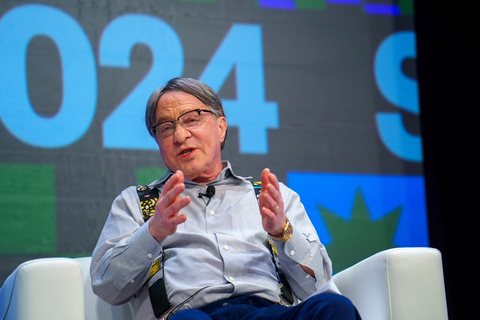

Field file 041
Ray Kurzweil
Raymond Kurzweil
LIVING — CHIEF AI OFFICER, BEYOND IMAGINATION (2025–); FORMER GOOGLE ENGINEERING DIRECTOR (2012–2025)
A of The Prophets in Transhumanism
Opened 2026-08-16 · verified 2026-08-16
A field file on a person in a public role, from the public record. Private lines (family, health, home, security, personal wealth) are kept at home and not shown.
I · Identity
- Full name
- Raymond Kurzweil, born February 12, 1948, Queens, New York.
- Age
- 78 as of this filing (turns 78 in Feb 2027 — card blurb's '77' is a year behind).
- Education
- MIT, BS in computer science and literature, 1970.
II · The Likeness & the Ground
- Self-image
- Presents as engineer-prophet: the man who built real machines (readers, synthesizers, OCR) before he built predictions, and treats the second as an extension of the first.
- Public persona
- Media shorthand is 'the ultimate thinking machine' (Forbes) and Google's chief futurist — a title Google itself never formally issued.
- Physical ground
- No temple, no campus — his authority sits in a body of books, patents, and a supplement regimen he has publicized for over three decades as a lived argument for his own thesis.
- Places of operation
- Numbered places match the list below. Coordinates locate the mapped places approximately; a pin does not show jurisdiction or a present private residence.
- MIT, Cambridge MA1965–1970
BS in computer science and literature; wrote pattern-matching software as an undergraduate. - Kurzweil Computer Products, Cambridge/Waltham MA1974–
Founded the company that built the first omni-font OCR system and the Kurzweil Reading Machine for the blind. - Google, Mountain View CA2012–2025
Director of Engineering, later Principal Researcher / AI Visionary, working on machine learning and language processing. - Beyond Imagination, Boston MA2013–present (Chief AI Officer 2025–)
Humanoid-robotics company he co-founded; current institutional post. - Alcor Life Extension Foundation, Scottsdale AZmember since decades ago
Site where his body is arranged to be vitrified in liquid nitrogen after legal death.
- MIT, Cambridge MA1965–1970
III · The Office
- This is not an office card
- Transhumanism has no institutional hierarchy — Kurzweil holds no ordained rank in a church-like structure. This suit ('The Prophets') tracks intellectual and cultural founders, not office-holders.
- Nearest thing to a post ★
- Director of Engineering, later Principal Researcher and AI Visionary, Google, Dec 2012 – 2025, working on machine learning and natural-language processing.
- Current institutional seat ★
- Chief AI Officer, Beyond Imagination (humanoid robotics company he co-founded in 2013), a role he assumed in 2025 as his Google tenure ended.
- Deck-card discrepancy partial
- The Ace of Spades blurb reads 'Age 77, at Google' — corroborating sources (unither.com leadership bio, MIT SHASS 2025 alumni page) place him at Beyond Imagination as of 2025, not Google. Treated here as a live decay item, not corrected silently.
- United Therapeutics
- Also listed as a Director on United Therapeutics' leadership page — an advisory/board seat, not an operating role.
- Kurzweil Technologies
- United Therapeutics' board biography lists him as CEO of Kurzweil Technologies since 1995, separate from his later Google and Beyond Imagination roles. Checked 2026-09-23: board biography.
IV · The Power
- What kind of authority this is
- Not jurisdiction — reach. He commands no institution and speaks for no organized body; his weight is the size of his readership, his patent record, and (until 2025) a seat inside one of the world's largest AI labs.
- Real institutional power
- For over a decade he had a working engineering role at Google, giving his predictions a rare direct line into what a frontier AI lab was actually building — genuine, if now past tense.
- Cultural power
- His books have shaped how a generation of technologists, journalists, and investors frame the AI and longevity conversation — 'the Singularity' and 'the Law of Accelerating Returns' are now common vocabulary well outside his own readership.
- No enforcement power
- He cannot compel any lab, government, or company to act on his timeline; his predictions are forecasts, not directives — the honest measure of his power is persuasion, not control.
V · Formation
- Early prodigy
- Built pattern-recognition software as an MIT undergraduate in the late 1960s, sold it to a publishing house before graduating.
- Kurzweil Computer Products
- Founded 1974; built the first omni-font OCR system, reading any typeface rather than one trained font.
- Reading Machine for the blind
- 1976: combined OCR with a text-to-speech synthesizer to unveil the first print-to-speech reading machine for the blind — endorsed publicly by Stevie Wonder, who became a customer and friend.
- Kurzweil Music Systems
- 1982; produced the K250 digital synthesizer (1984), the first to convincingly reproduce a grand piano and full orchestral instrument set.
- Speech recognition
- Kurzweil Applied Intelligence (1987) shipped the first commercially marketed large-vocabulary speech-recognition software.
- Patents & honors
- Holds numerous US patents; recipient of the National Medal of Technology (1999), the Lemelson-MIT Prize ($500,000, 2001), and induction into the National Inventors Hall of Fame (2002).
- Google entry
- Recruited by Larry Page in December 2012 to focus on machine learning and language understanding.
VI · The Ties
- No central church
- Transhumanism has no pope and no synod — it is a loose network of authors, labs, and advocacy nonprofits, chief among them Humanity+ (formerly the World Transhumanist Association).
- This deck's suits
- Deck structure: ♦ The Builders (constructing AGI, longevity & neurotech), ♦ The Patrons (the capital funding it, e.g. Peter Thiel), ♠ The Prophets (living founders & philosophers — Kurzweil's suit), ♠ The Watchmen (the safety camp and the movement's own internal critics).
- King of the suit ★
- Nick Bostrom, 52, author of Superintelligence (2014) and Deep Utopia (2024); founding director of Oxford's Future of Humanity Institute until Oxford closed it in April 2024 amid a bureaucratic dispute; now runs the independent nonprofit Macrostrategy Research Initiative.
- Watchmen as counterweight
- The deck's fourth suit exists partly as a direct answer to Kurzweil's optimism — the safety camp (figures like Gary Marcus and various AI-risk researchers) is structurally positioned against this suit's prophets, not merely adjacent to them.
- Cryonics network
- Fellow Alcor members include Peter Thiel and DJ/entrepreneur Steve Aoki — a small, wealthy, overlapping circle rather than a mass movement.
- Beyond Imagination
- Co-founded 2013 with Harry Kloor; humanoid robotics company where Kurzweil now serves as Chief AI Officer.
VII · Doctrine & Position
- The Law of Accelerating Returns
- His central thesis: evolutionary and technological systems improve at an exponential, not linear, rate — computing power, genome sequencing cost, and related metrics have historically tracked this curve.
- AGI prediction — his position
- Predicts a machine will pass a rigorous Turing-style test and achieve human-level general intelligence by 2029; restated unchanged in The Singularity Is Nearer (2024).
- AGI prediction — mainstream contrast partial
- Independent surveys of AI researchers (e.g. AI Impacts / Metaculus aggregate forecasts) have historically clustered median AGI-arrival estimates in the 2040s–2060s, decades later than Kurzweil's date — his 2029 figure sits well outside that consensus band, not inside it.
- The Singularity — his position
- Predicts human intelligence will merge with AI by 2045, a moment he terms the Singularity, after which the pace of change becomes effectively incomprehensible to unaugmented humans.
- Longevity escape velocity
- Argues medical technology's rate of life-extension gains will outpace aging itself within his own lifetime, allowing him (and others alive today) to reach a point where remaining lifespan effectively stops shrinking with each passing year — the stated rationale behind his supplement regimen and cryonics backup plan.
- THE MACHINE QUESTION — his stated answer partial
- Kurzweil's own position is unambiguous and public: he expects machine intelligence to equal, then exceed, human intelligence within this decade, and expects biological and digital intelligence to merge rather than remain separate — this is a personal forecast, not a demonstrated event.
- 2024 book's update from 2005
- The Singularity Is Nearer (2024) keeps the 2029/2045 dates from The Singularity Is Near (2005) but adds the intervening two decades of evidence — GPT-era large language models, CRISPR, and genome-sequencing cost drops — as the argument for why the curve is still on schedule.
- Named obstacles to AGI, per Kurzweil (2024)
- He identifies three specific gaps holding back current systems: contextual memory limitations, common sense, and social interaction — and predicts all three close by 2029.
VIII · The Sword & the State
- No sword
- He holds no state power, regulatory authority, or enforcement mechanism of any kind — his only lever is publication and public argument.
- Policy contact
- Has testified and spoken before US government bodies on AI and technology policy over decades, but as an invited expert witness, not an office-holder.
- Google's relationship to policy
- During his Google tenure his AI work sat inside a company that itself lobbies and shapes AI policy — an indirect institutional proximity to state power, now ended with his 2025 departure.
IX · Conflict & Controversy
- Named skeptics
- Prominent critics of his extrapolation method include philosopher Daniel Dennett, roboticist Rodney Brooks, computer scientist David Gelernter, and Microsoft co-founder Paul Allen — all arguing his curves oversimplify biological and computational complexity.
- Gary Marcus critique
- Cognitive scientist Gary Marcus has written pointed public critiques of Kurzweil's theory of mind and AGI timeline (including in The New Yorker and on Substack), maintaining AGI will not arrive by 2029 — one of the more sustained named opponents in the current AI debate.
- Bias charge
- Multiple commentators note his personal stake in defeating aging and death gives him an incentive to forecast optimistically — a conflict-of-interest critique aimed squarely at the credibility of his timeline, not just its content.
- 2009 predictions scored poorly partial
- A Forbes review of specific 2009-dated predictions from his earlier books found seven wrong, four partial, one correct — a notably worse showing than his self-reported aggregate figures.
- Newsweek critique
- Journalist Daniel Lyons publicly catalogued a set of his failed near-term predictions, arguing the long-range hits get remembered while the short-range misses get quietly dropped from his own tallies.
- Cryonics itself is contested
- Cryonics preservation and eventual revival remain scientifically unproven — no vitrified human has ever been successfully revived; Kurzweil's Alcor arrangement is a bet on future technology, not a demonstrated procedure.
X · The Standing
- Self-claimed accuracy partial
- Kurzweil states that of 147 predictions in 1999's The Age of Spiritual Machines, 115 were 'entirely correct,' 12 'essentially correct,' 17 'partially correct,' and 3 wrong — yielding his oft-cited ~86% accuracy figure. This is his own self-graded tally.
- Independent scorecards diverge partial
- Third-party reviews (Forbes' 2009 spot-check, Newsweek's Daniel Lyons, and multiple later retrospectives after the 2022–2024 LLM boom) find a mixed record: strong hits on general trends he named early — smartphones, cloud computing, ubiquitous internet, wearable and mobile computing — set against a consistent pattern of timeline optimism, where the direction was right but the date was years to decades early.
- Honest synthesis partial
- Neither his 86% figure nor the harshest critic tallies should be taken as the final word — the two use different counting rules (his own broad, self-graded categories vs. critics' narrower pass/fail reading of specific dated claims) and are not measuring the same thing.
- Institutional standing today
- Chief AI Officer at a robotics company he co-founded — a real but modest operating title next to his cultural reach as an author and speaker.
- Not an office
- Consistent with the card's own framing: his authority in this deck is the weight of prediction and publication, not any granted jurisdiction.
XI · The File
- Card position
- Ace of Spades, ♠ The Prophets, Transhumanism deck — Dossier III.
- Companion King
- Nick Bostrom, 52 — Superintelligence (2014), Deep Utopia (2024).
- Central falsifiable claim
- AGI by 2029 — three years out from this filing, and the single most checkable line on his record.
- Central unverifiable claim unverified
- Cryonics revival — cannot be assessed one way or the other; no case exists yet to check against.
- Decay note
- This file already caught the deck card behind the record on his employer (Google → Beyond Imagination, 2025); expect similar drift on age, title, and pill count at next verification pass.
XII · The Timeline
- 1995 · technology company
- Began serving as CEO of Kurzweil Technologies. Timeline checked 2026-09-23. Primary source. Other sections retain their original verification dates.
- 2002 · inventors recognition
- Inducted into the National Inventors Hall of Fame.
- 2013-2025 · Google
- Joined Google in January 2013, serving in engineering and later research roles through 2025.
- 2025 · robotics
- Became Chief AI Officer at Beyond Imagination, which he co-founded in 2013.
XIII · The House Reading
- Place in the landscape
- Kurzweil combines an inventor's record, corporate roles, and public technological forecasts. Those are different kinds of authority and should occupy separate lines in the house's assessment. House analysis written 2026-09-23; these applications are inferences, not the subject's statements about this house.
- What could help this house
- Learn from useful assistive inventions: judge technology by a demonstrated improvement in someone's ability to read, communicate, or act. Keep dated predictions in a ledger with a clear test for whether they came true.
- What could hurt this house
- Past inventions can lend unearned certainty to future predictions. The house should not turn a forecast about AI or longevity into a promise, a doctrine, or a reason to neglect present responsibilities.
- Boundary and next evidence
- A board biography verifies the company's account of career appointments. Test technical claims against working systems and independent measurements; evaluate health claims against relevant clinical evidence.
Sources
- Ray Kurzweil — Wikipedia
- Ray Kurzweil — United Therapeutics Leadership bio
- 2025 | Ray Kurzweil — MIT SHASS
- Ray Kurzweil ’70 receives the 2025 Robert A. Muh Alumni Award — MIT SHASS
- The Singularity Is Nearer — Wikipedia
- Ray Kurzweil's New Book: The Singularity is Nearer — EDRM
- "The Singularity Is Nearer" by Ray Kurzweil — Review, LessWrong
- Kurzweil Defends His Predictions Again: Was He 86% Correct? — Singularity Hub
- Ray Kurzweil's Prediction Scorecard Now That ChatGPT Is Here — Medium
- Ray Kurzweil Predictions Scorecard: What He Got Right & Wrong — TechEngage
- Ray Kurzweil on Memory and Cryonics — Alcor Cryonics Archive
- List of people who arranged for cryonics — Grokipedia
- Everybody Freeze! — The Baffler
- Google Futurist Ray Kurzweil Hacks His Body — LongevityFacts
- Clarification from Ray Kurzweil — Gary Marcus Substack
- Are AI existential risks real—and what should we do about them? — Brookings
- The Promise and Peril of AI — Ray Kurzweil, TIME
- Ray Kurzweil: Don't Fear Artificial Intelligence — TIME
- "Deep Utopia" by Nick Bostrom — nickbostrom.com
- Future of Humanity Institute — Wikipedia
- Nick Bostrom Curriculum Vitae
- Timeline primary source checked 2026-09-23; house applications are editorial analysis