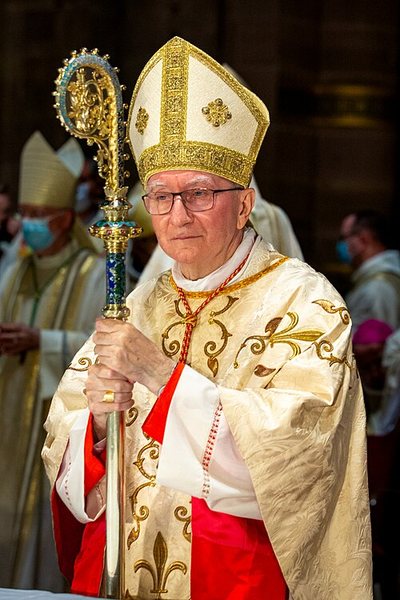

Field file 002
Cardinal Pietro Parolin
Pietro Parolin
IN OFFICE · REPLACEMENT RUMOURED
K of The Helm in The Roman Catholic Church
Opened 2026-07-25 · verified 2026-07-25
A field file on a person in a public role, from the public record. Private lines (family, health, home, security, personal wealth) are kept at home and not shown.
I · Identity
- Full legal name
- Pietro Parolin. A diocesan priest of Vicenza, not a member of any religious order — which matters: he took no vow of poverty and belongs to no brotherhood with a claim on him.
- Name in office
- Cardinal Secretary of State — the oldest and most powerful office in the Roman Curia, and the closest thing the Church has to a prime minister.
- The distinction ★
- He presided over the conclave that elected someone else pope. As the most senior cardinal-bishop under eighty, he ran the 2025 conclave from the chair — while being the bookmakers' favourite to win it.
- Date of birth
- 17 January 1955 — age 71. Four months older than the pope he serves.
- Place of birth
- Schiavon, province of Vicenza, in the Veneto, northern Italy.
- Nationality
- Italian. Holds a Vatican diplomatic passport by office.
- Languages partial
- Italian, and the working languages of Vatican diplomacy — French, Spanish and English are reported. Not verified to a specific list.
II · The Likeness & the Ground
- Places of operation
- This is a diplomat's map, and it reads differently from the pope's. Leo's pins are a life that happened to him — born here, sent there. Parolin's are postings: a career assembled deliberately, Nigeria to Mexico to Caracas, each one a rung, each one chosen for him by the institution he now runs.
- Schiavon, Vicenza1955 — born
A small town in the Veneto. Son of a hardware-store manager and a primary-school teacher; his father was killed in a car crash when he was ten. - Vicenza1969–1980 — seminary
Entered the seminary at fourteen — the same age Prevost entered the Augustinians. Ordained priest for the Diocese of Vicenza, 27 April 1980. - Rome1980s — trained
Canon law at the Pontifical Gregorian University, then the Pontifical Ecclesiastical Academy — the school that produces the Holy See's diplomats. - Nigeriafrom 1986 — first posting
Entered the diplomatic service of the Holy See on 1 July 1986. Nigeria was the first station. Pin marks the country, not a confirmed city. - Mexico Citysecond posting
Where he made his name: a pivotal role in restoring diplomatic relations between Mexico and the Holy See. Reported, dates not confirmed here. - Caracas, Venezuela2009–2013 — nuncio
Named Apostolic Nuncio to Venezuela 17 August 2009 and ordained bishop 12 September 2009. Four years as Rome's ambassador to a country in collapse. - Vatican City2002–2009, 2013– · the desk
Undersecretary for Relations with States from 30 November 2002; back as Secretary of State on 15 October 2013. Thirteen years running the machine.
- Schiavon, Vicenza1955 — born
III · The Office
- Exact title
- Cardinal Secretary of State of His Holiness — head of the Secretariat of State, the department through which all Vatican governance and all Holy See diplomacy passes.
- Held since ★
- Appointed 31 August 2013 by Pope Francis; entered office 15 October 2013. Thirteen years, spanning two pontificates.
- How he got it
- Appointed by the pope, and serving entirely at the pope's pleasure. Unlike the papacy, this office has no election, no term and no protection.
- Confirmed under Leo
- Leo XIV kept him on in May 2025 — reported at the time as a confirmation rather than a settled reappointment. He was still signing for the Holy See on 8 July 2026, on the pope's message to the AI for Good Summit.
- Term length
- None. He serves until the pope removes him, and a Secretary of State's mandate lapses automatically when a pope dies — which is exactly what happened to him in April 2025.
- Who can remove him
- Leo XIV, at will, without stating a reason. That is the whole answer, and it is the difference between the King and the Ace of this suit.
- The open question ★
- As of 15 July 2026, the Catholic press was still framing his replacement as “one of the remaining great unknowns of the Leonine pontificate” — a Francis-era department head serving a pope who has shown he will remove people. No change has been announced.
- Curial seats
- Member of the Dicasteries for the Doctrine of the Faith, the Eastern Churches, Evangelization, Bishops, and Divine Worship. He sits inside five of the machines he coordinates.
IV · The Power
- Scope
- Every piece of paper that reaches the pope, and every one that leaves him. The Secretariat of State is the choke point of the entire Roman Curia.
- Diplomacy partial
- He runs the Holy See's diplomatic service — around 180 states and a Permanent Observer seat at the UN — and the nunciatures that staff it. Exact current count not verified.
- Hard power
- Little of his own. He cannot appoint a bishop, define a doctrine or excommunicate anyone. Every instrument he uses is borrowed from the man above him — which is precisely why the office is dangerous to hold and easy to lose.
- Soft power
- Enormous. Access, sequencing, and the drafting pen. He decides what reaches the pope's desk and in what order, and he signs the Holy See's word to governments.
- The China file ★
- He is the architect and defender of the 2018 Vatican–China provisional agreement on the appointment of bishops, renewed repeatedly since. He presides over the joint commission with Beijing, which meets twice a year. This is the single most contested thing he has done.
- Chain of command
- Answers to Pope Leo XIV alone (A♠). Below him sits the Sostituto for general affairs (9♠) and the Secretary for Relations with States (10♠) — the two halves of his department.
- Who he answers to
- One man. He is the most powerful official in the Catholic Church who can be dismissed by a single sentence.
- Institutional money unverified
- UNVERIFIED. The Secretariat of State's budget and its investment holdings — the subject of the Vatican's financial scandals of the last decade — could not be confirmed to a current figure on 25 July 2026.
V · Formation
- Father partial
- A hardware-store manager, killed in a car accident when Parolin was ten years old. Widely reported; the detail recurs in every profile of him.
- Mother partial
- An elementary-school teacher. Reported, not verified against a record.
- Entered religion
- Entered the seminary at fourteen. Note the symmetry with the pope he serves, who entered the Augustinians at the same age — both men have been inside the institution since childhood.
- Education
- Canon law at the Pontifical Gregorian University, Rome, and a diploma in diplomatic sciences from the Pontifical Ecclesiastical Academy — the Holy See's diplomatic school, and the entry ticket to the career he has had.
- Ordination
- Ordained priest 27 April 1980 for the Diocese of Vicenza. Ordained bishop 12 September 2009, on being sent to Caracas.
- The diplomatic years
- Entered the Holy See's diplomatic service 1 July 1986. Postings in Nigeria and Mexico, where he is credited with a pivotal role in restoring Mexican–Vatican relations.
- The climb
- 1986 diplomatic service → 30 Nov 2002 Undersecretary for Relations with States → 17 Aug 2009 Nuncio to Venezuela, made archbishop → 31 Aug 2013 Secretary of State → 22 Feb 2014 Cardinal, titular church Santi Simone e Giuda Taddeo a Torre Angela → later raised to the order of cardinal-bishops, which is what put him in the chair at the 2025 conclave.
VI · The Ties
- Known associates ★
- The patron — deceased: Pope Francis appointed him in 2013 and kept him for twelve years. Parolin is the last great survivor of that government.Above him: Pope Leo XIV (A♠) — the man he presided over the election of, and now serves.His own department: Abp Paul Richard Gallagher (10♠), Secretary for Relations with States · Abp Paolo Rudelli (9♠), the Sostituto.The Dean who called the conclave: Cardinal Giovanni Battista Re (Q♠) — over eighty, which is why Parolin took the chair inside it.His rival in 2025: Cardinal Luis Antonio Tagle (Q♦), the other bookmakers' favourite; both lost to a man on nobody's shortlist.Counterparty: the government of the People's Republic of China, through the joint commission he chairs.
- Timeline
- 1955 born, Schiavon · c.1969 enters seminary at 14 · 27 Apr 1980 ordained priest, Vicenza · 1 Jul 1986 enters Holy See diplomatic service · Nigeria, then Mexico · 30 Nov 2002 Undersecretary for Relations with States · 17 Aug 2009 Nuncio to Venezuela · 12 Sep 2009 ordained bishop · 31 Aug 2013 named Secretary of State · 15 Oct 2013 enters office · 22 Feb 2014 created Cardinal · 2018 Vatican–China agreement signed · 21 Apr 2025 Francis dies, his mandate lapses · May 2025 presides over the conclave; Prevost elected on the fourth ballot · May 2025 confirmed by Leo XIV · 8 Jul 2026 signs the pope's AI for Good message · 22 Jul 2026 on Ukraine: escalation, no prospect of peace.
- His own channels
- He does not publish in his own name. His official biography is at the Holy See Press Office, and his words reach the public through Vatican News and the Vatican bulletin. A Secretary of State's medium is the communiqué, not the book.
VII · Doctrine & Position
- School
- Not a theologian — a diplomat. He is a canon lawyer by training and a career nuncio by formation, and his instinct in every file is negotiation, continuity and the long horizon.
- THE MACHINE QUESTION partial
- He has no position of his own on record — and that is the finding. He signed Pope Leo's message to the AI for Good Global Summit on 8 July 2026, which is the Holy See's formal voice on artificial intelligence. But the argument in it is Leo's, from Magnifica Humanitas. Parolin is the instrument by which the Church's answer to the machine is transmitted to governments, not its author. No independent Parolin statement on AI was found on 25 July 2026.
- IN TECH NOW partial
- Transmission, not authorship. He signed the pope's message to the AI for Good Global Summit (8 July 2026) — the Holy See's formal voice on AI to the UN system — but has no technology program or position of his own on record. If Rome's answer to the machine becomes treaties, it becomes his file.
- Where his weight actually falls
- Not on the soul but on the state. If Rome's answer to artificial intelligence ever becomes diplomacy — treaties, UN texts, pressure on governments — it becomes his file, not the pope's. Watch this line: it is the route by which Dossier XII's finding would turn into policy.
- Ukraine ★
- 22 July 2026, at Palazzo Borromeo in Rome: asked about the war, he said “there is an escalation, while the prospects for peace remain nonexistent.” He has led the Holy See's peace efforts throughout, including approaches through Beijing.
- Iran
- In the same July 2026 remarks he urged renewed negotiations with Iran as that war continued — the Holy See's standing position being that no war ends without a table.
- Signature posture
- Continuity, quietly. In thirteen years he has produced no manifesto, no encyclical, no book — and that is the job. The Secretary of State who becomes the story has already failed at it.
- What he is criticised for
- China. Critics — including human-rights groups and a substantial bloc of Catholics — argue the 2018 agreement conceded too much to Beijing over the appointment of bishops and abandoned the underground Church that had suffered for refusing state control. He has defended it consistently as the least bad option available.
VIII · The Sword & the State
- What he is, in state terms
- Foreign minister and head of government of a sovereign state, rolled into one office — plus chief of staff to an absolute monarch.
- The China agreement
- The 2018 provisional agreement on the appointment of bishops, renewed repeatedly, with a joint commission he personally presides over meeting twice a year. It is the only formal arrangement between the Holy See and Beijing, and the most consequential act of his career.
- Venezuela
- Four years as nuncio in Caracas, 2009–2013, under Chávez — the posting that gave him first-hand experience of a church operating under a hostile government, which is the same problem the China file poses.
- Mexico
- Credited with a pivotal role in the restoration of diplomatic relations between Mexico and the Holy See — a country whose constitution had been militantly anticlerical within living memory.
IX · Conflict & Controversy
- The China backlash partial
- The 2018 deal drew sustained attack from Catholics and human-rights organisations who held that it gave Beijing too much control over who becomes a bishop and betrayed those who had refused to join the state-sanctioned church. Cardinal Joseph Zen of Hong Kong became its most prominent critic. Zen's role is well documented but not re-verified here.
- The conclave he lost
- He went into May 2025 as the betting favourite, odds shortening to 12/5 as the doors closed, ahead of Tagle. On the fourth ballot the cardinals chose Robert Prevost. The old rule held: he who enters a conclave a pope leaves it a cardinal.
- The financial shadow partial
- The Secretariat of State he inherited and ran was the department at the centre of the Vatican's London property scandal and subsequent financial trials, which stripped it of its investment autonomy. His personal role was not the subject of the convictions; details not re-verified here.
- The survivor problem
- He is now the most senior holdover of the previous pontificate in a government being remade. Every month he stays is read as a signal, and so would be the day he goes.
X · The Standing
- Immunity & legal shield partial
- Holds the Holy See's diplomatic status and functional immunity as its chief diplomat. The precise extent under any given national law was not verified. He has no personal immunity from the pope, which is the only jurisdiction that decides his future.
XI · The File
- Why the King
- Because he is the second power in the Church and the first among its servants — but everything he holds is delegated and revocable. The Ace answers to nobody; the King answers to the Ace, and can be gone by lunchtime. That gap is the whole distance between these two cards.
- Cross-references
- Dossier II (Roman Catholicism) · A♠ Leo XIV, who kept him · Q♠ Re, whose age put him in the conclave chair · 9♠ Rudelli and 10♠ Gallagher, his two deputies · Q♦ Tagle, his rival in 2025 · 8♥ Chow of Hong Kong, who lives inside the China question Parolin negotiated.
- The one thing to know ★
- He ran the election he was favourite to win, and handed the ring to another man. Then he stayed. For thirteen years Pietro Parolin has been the hand that moves the Catholic Church's machinery day by day — through two popes, a China agreement his own side calls a betrayal, and two wars he cannot stop — and he has never once been the story, because the moment he is, he is finished.
XII · The Timeline
- 1980–1986 · formation and diplomacy
- Ordained in 1980; entered the Holy See's diplomatic service on 1 July 1986. Timeline checked 2026-09-23. Primary source. Other sections retain their original verification dates.
- 2002 · relations with states
- Appointed undersecretary for Relations with States on 30 November.
- 2009 · Venezuela
- Appointed nuncio to Venezuela on 17 August and consecrated bishop on 12 September.
- 2013–2014 · secretary of state
- Entered office as secretary of state on 15 October 2013; created cardinal in February 2014.
XIII · The House Reading
- Place in the landscape
- Parolin is a senior diplomatic and coordinating officer of the Holy See. State relationships and religious leadership overlap here, but they are not the same kind of authority. House analysis written 2026-09-23; these applications are inferences, not the subject's statements about this house.
- What could help this house
- Separate agreement to cooperate from agreement about belief. The house can work with a neighbour on a specific shared task while writing down the limited purpose of the cooperation.
- What could hurt this house
- A useful agreement can become pressure to stay silent about an unrelated wrong. Before accepting institutional help, identify what is expected in return and who may end the arrangement.
- Boundary and next evidence
- The Vatican's diplomatic capacity cannot be copied by a family. This file establishes no relationship between Parolin and the house. Study the actual terms and outcomes of a named agreement before treating diplomatic access as success.
Sources
- Holy See Press Office — official biography, Card. Pietro Parolin
- Holy See Press Office bulletin — AI for Good Global Summit message, signed by Parolin, 08.07.2026
- Vatican News — Cardinal Parolin urges renewed Iran talks as Ukraine peace remains elusive (July 2026)
- Aleteia — Parolin: Peace in Ukraine 'moving in the wrong direction' (24 July 2026)
- The Pillar — Who could be Leo's pick for Secretary of State, whenever it comes? (15 July 2026)
- Vatican News — Cardinal Parolin: Pope Leo goes forward on his path and preaches peace (May 2026)
- Wikipedia — Pietro Parolin
- Wikipedia — 2025 conclave
- Newsweek — Favorite emerges to replace Francis as conclave starts
- Rome Reports — Parolin focuses on Europe and China as key elements for peace in Ukraine
- Wikimedia Commons — portrait, Claude Truong-Ngoc, CC BY-SA 4.0
- Wikimedia Commons — BlankMap-Equirectangular.svg, CC0 (base map)
- Timeline primary source checked 2026-09-23; house applications are editorial analysis

