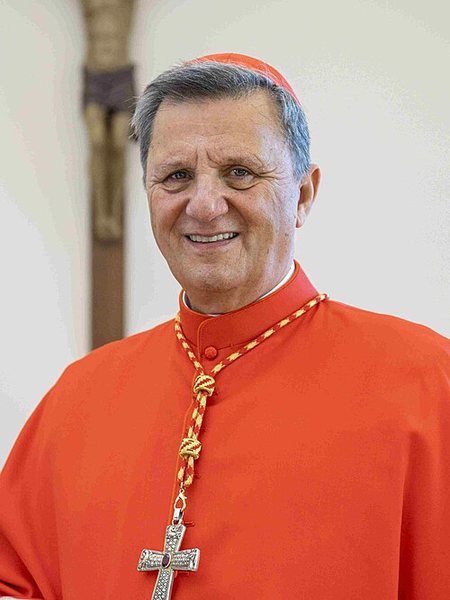

Field file 009
Cardinal Mario Grech
Mario Grech
IN OFFICE · BUILDING TOWARD 2028
6 of The Helm in The Roman Catholic Church
Opened 2026-07-26 · verified 2026-07-26
A field file on a person in a public role, from the public record. Private lines (family, health, home, security, personal wealth) are kept at home and not shown.
I · Identity
- Full legal name
- Mario Grech. A priest of the Diocese of Gozo — the smallest home diocese of anyone in this suit.
- Name in office
- Secretary General of the Synod of Bishops. The office that runs the Church's consultative process — and, since 2021, the largest consultation the Catholic Church has ever attempted.
- The distinction ★
- He changed his mind in public, and it changed his career. As Bishop of Gozo he was reckoned a conservative, sometimes at odds with Malta's own archbishop. As Secretary General he became the standard-bearer of synodal reform. Nobody else in this suit has a documented reversal at all.
- Date of birth
- 20 February 1957 — age 69.
- Place of birth
- Qala, on the island of Gozo, Malta.
- Nationality
- Maltese. The only Maltese card in this suit, and the smallest country represented in it.
- Languages partial
- Maltese, Italian and English at working level — Malta is bilingual and his Roman degrees were taken in Italian. No verified full list found.
II · The Likeness & the Ground
- Places of operation
- Two clusters, and that is all: a small Mediterranean island and Rome. Like Reina (8♠) his map is tiny — but note the difference in what it means. Reina's smallness is provincial; Grech's is insular in the literal sense. He came from a diocese of a few tens of thousands of people and now runs a process that consulted millions.
- Qala, Gozo1957 — born
Born 20 February 1957 in a village on Gozo — the smaller of Malta's two inhabited islands, population in the tens of thousands. - Victoria, Gozo1957–1984 · 2005–2019
Schooled at the Victoria Lyceum, then philosophy and theology at the Gozo diocesan seminary. Returned as Bishop of Gozo from 2005 to 2019. - Romeafter 1984 — trained
Licentiate in utroque iure — both civil and canon law — at the Pontifical Lateran University, and a doctorate in canon law at the Angelicum. - Vatican City2019– · the Synod
Pro-Secretary General of the Synod of Bishops from 2 October 2019; Secretary General from 15 September 2020; Cardinal 28 November 2020.
- Qala, Gozo1957 — born
III · The Office
- Exact title
- Secretary General of the Synod of Bishops — head of the permanent secretariat that convenes, prepares and runs the Church's synodal assemblies.
- Held since
- Pro-Secretary General from 2 October 2019, then Secretary General from 15 September 2020. Cardinal from 28 November 2020.
- What he built ★
- The Synod on Synodality, 2021–2024 — a worldwide consultation inviting Catholics everywhere to say what they hoped and feared about the Church. Millions responded, and the Vatican permitted open discussion of subjects previously treated as closed.
- The current phase
- In March 2025 Francis approved a three-year implementation phase, and on 21 May 2026 the synod office published “The Path of Implementation of the Synod.” Dioceses, bishops' conferences and religious communities are to fold synodality into ordinary life.
- The destination ★
- An ecclesial assembly at the Vatican in October 2028 — to “gather the fruits of the journey” and give the pope, in Grech's words, “a real ecclesial experience to inform his discernment as the successor of Peter.”
- How he got it
- Appointed by Pope Francis from the see of Gozo, and held at the pope's pleasure.
- Who can remove him
- Leo XIV, at will — and the more interesting question is not removal but whether Leo wants the 2028 assembly at all. It was his predecessor's design. He has let it proceed.
- Chain of command
- Answers to Leo XIV (A♠) directly. Works alongside Cardinal Jean-Claude Hollerich (5♠), Relator General — the synod's two-man leadership.
IV · The Power
- Scope
- Every diocese on earth, through the consultation process — but by invitation rather than command.
- Hard power
- None. The Synod advises; it does not legislate. Its conclusions become binding only if a pope adopts them.
- Soft power
- Agenda-setting on a planetary scale. He decides what question the Church is asked, and in what words. Whoever writes the questionnaire shapes the answer, and for five years that has been this office.
- The method
- “Local Churches, not Rome, are the centre of synodal implementation” — his line to the Asian bishops. Deliberate decentralisation, which is either the point of the reform or the reason critics call it unaccountable.
- What he says it is not
- Not bureaucracy. He has framed the implementation phase as “not an additional task but rather a time of shared discernment and thanksgiving” and “a profound ecclesial and spiritual experience.”
- Who he answers to
- The pope alone. Like Reina and Petrini, this card sits outside the Secretariat of State chain.
- Budget unverified
- UNVERIFIED. The synod secretariat's budget could not be confirmed.
- Staff unverified
- UNVERIFIED. No current figure for the secretariat's establishment was found.
V · Formation
- Education
- Victoria Lyceum, Gozo · philosophy and theology at the Gozo diocesan seminary · licentiate in utroque iure at the Pontifical Lateran University · doctorate in canon law at the Angelicum. A double lawyer — civil and canon both.
- Ordination
- Ordained priest 26 May 1984 for the Diocese of Gozo, aged 27.
- Bishop of Gozo
- Appointed 26 November 2005 by Benedict XVI, and served until 2 October 2019 — fourteen years as bishop of his own home island.
- The reputation he had
- Through those Gozo years he was generally considered a conservative, standing to the right of — and sometimes at odds with — Archbishop Charles Scicluna of Malta.
- The turn ★
- That reputation dissolved after 2019. In the synod office he became a champion of Francis's vision and of the reform causes the synod came to stand for. Whether that is conversion, obedience, or a man finally given room is the open question of this file.
- The climb
- 1984 ordained, Gozo · Rome for both laws · 26 Nov 2005 Bishop of Gozo · 2 Oct 2019 pro-Secretary General of the Synod · 15 Sep 2020 Secretary General · 28 Nov 2020 created Cardinal · 2021–24 the Synod on Synodality · 2025 implementation phase approved · 2028 the assembly.
VI · The Ties
- Known associates ★
- The patron: Pope Francis — took him from Gozo in 2019, made him Secretary General in 2020 and a cardinal weeks later. The whole second half of his career is Francis's doing. Deceased.His partner in the office: Cardinal Jean-Claude Hollerich (5♠), Relator General of the Synod — the two run it together.The other synod voice: Cardinal Timothy Radcliffe (8♣), preacher and retreat-master to the process.Who appointed him bishop: Benedict XVI, in 2005. Deceased.His old counterweight: Archbishop Charles Scicluna of Malta, to whose left Grech eventually moved.Above him: Leo XIV (A♠), who has let the 2028 assembly proceed.
- Timeline
- 20 Feb 1957 born, Qala, Gozo · Victoria Lyceum; Gozo seminary · 26 May 1984 ordained priest · licentiate in utroque iure, Lateran; doctorate in canon law, Angelicum · 26 Nov 2005 appointed Bishop of Gozo by Benedict XVI · 2 Oct 2019 pro-Secretary General of the Synod of Bishops · 15 Sep 2020 Secretary General · 28 Nov 2020 created Cardinal · 2021–2024 the Synod on Synodality · May 2025 named among the papabili in the conclave that elected Leo XIV · Mar 2025 implementation phase approved · 21 May 2026 “The Path of Implementation of the Synod” published · Oct 2028 ecclesial assembly.
- His own channels
- The General Secretariat of the Synod publishes his documents and addresses; his official biography sits at the Holy See Press Office. He gives interviews readily — unusually so for this suit — which is how the shift in his thinking is documented at all.
VII · Doctrine & Position
- School
- Canon lawyer turned process theologian. Trained in both civil and canon law; converted by the job into an advocate of discernment and participation rather than of statute.
- THE MACHINE QUESTION unverified
- UNVERIFIED — nothing found. No statement by Cardinal Grech on artificial intelligence surfaced on 26 July 2026. But note what this office uniquely possesses: the synod is the only mechanism in the Catholic Church that asks ordinary Catholics what they think, and it asked millions between 2021 and 2024. If Rome ever wants to know what its own people believe about the machine — rather than what its theologians conclude — this is the only instrument that could find out.
- IN TECH NOW unverified
- UNVERIFIED — no AI statement found. His relevant asset is infrastructural: the synod's worldwide consultation (millions of responses, 2021–24) is the only mass digital listening instrument the Catholic Church possesses. Whether the machine question reaches the 2028 assembly floor is a decision that runs through his desk.
- Where his weight could fall ★
- On the 2028 assembly agenda. Leo has made AI the subject of his pontificate; Grech controls what the worldwide Church is formally asked to discern. Whether the machine question reaches the 2028 floor is a decision that runs through this desk.
- Synodality
- His whole position: a Church where everyone participates in decisions and mission, implemented by local churches rather than Rome. Critics read it as diffusing accountability; he reads it as restoring it.
- Signature line
- The implementation phase is “not an additional task but rather a time of shared discernment and thanksgiving” — a sentence designed to disarm bishops who suspect they are being given homework.
- Published works unverified
- UNVERIFIED as a personal bibliography. His output is institutional: synod working documents, Instrumentum Laboris texts, and the 2026 implementation path.
- What he has changed his mind about ★
- The rarest entry in this suit — an actual answer. He entered the synod office with a conservative reputation from fourteen years as a Maltese bishop, and became the most prominent institutional champion of the reform agenda. Whichever reading you take, it is on the record, and nobody else's is.
VIII · The Sword & the State
- State standing
- None. The Synod is an internal ecclesial body with no civil dimension whatsoever — the only card in this suit of which that is simply true.
- Malta
- A country of under half a million people has produced the man running the Church's global consultation. Gozo alone has a population smaller than many parishes he now consults.
- Asia
- He has taken the implementation argument to the Federation of Asian Bishops' Conferences, telling them the centre of the work is their local churches, not Rome — the practical test of whether decentralisation is meant.
- The 2025 conclave ★
- He was named among the papabili — the front-runners discussed before the conclave that elected Leo XIV, and dubbed by one outlet “the Maltese Falcon.” He was a candidate for the chair now held by A♠.
IX · Conflict & Controversy
- The synod itself ★
- The controversy is the job. The 2021–24 process allowed open discussion of subjects long treated as closed, which conservatives read as an engineered opening and reformers as an unfinished one. Grech is attacked from both directions — by traditionalists for what the synod discussed, and by reformers for what it did not decide.
- The reversal partial
- His shift from conservative Gozo bishop to synodal champion is read by critics as opportunism and by supporters as genuine conversion through the work. No statement by him settling the question was found.
- Scandals
- None found. No scandal, accusation or proceeding against him surfaced in this check. Recorded as a negative finding, not an absence of looking.
- Rivals partial
- Archbishop Charles Scicluna of Malta, historically — the two were reckoned to be on opposite sides of Maltese church argument. No current dispute verified.
X · The Standing
- Immunity & legal shield unverified
- UNVERIFIED. No specific determination checked.
XI · The File
- Why the Six
- Because the Synod advises and does not govern. He commands no diocese, no dicastery and no budget of consequence, and every conclusion he gathers is only a recommendation. But he sets the question the whole Church is asked, and he was a candidate for the papacy fourteen months ago. A six that punches above itself.
- Cross-references
- Dossier II · A♠ Leo XIV, who has let 2028 proceed · 5♠ Hollerich, his Relator General · 8♣ Radcliffe, preacher to the synod · Q♠ Re, whose June 2026 letter put the synod on the College's agenda alongside Magnifica Humanitas.
- The one thing to know ★
- He is the only man in this suit who is on record having changed his mind. A conservative bishop of a Maltese island of thirty thousand people was handed the machinery of the Church's global consultation and became the champion of the reform his old reputation opposed. He asked millions of Catholics what they thought, and he is now building toward an assembly in October 2028 where the answers are supposed to matter. He controls the only instrument Rome has for finding out what its own people believe — including about the machine, if anyone thinks to ask.
XII · The Timeline
- 1984 · ordination
- Ordained on 26 May, then pursued legal studies in Rome. Timeline checked 2026-09-23. Primary source. Other sections retain their original verification dates.
- 2005–2006 · Gozo
- Appointed bishop of Gozo in November 2005 and consecrated in January 2006.
- 2019 · Synod secretariat
- Appointed pro-secretary general on 2 October.
- 2020 · secretary general and cardinal
- Became secretary general on 15 September and cardinal on 28 November.
XIII · The House Reading
- Place in the landscape
- Grech's route runs through canon law, a small diocese, and coordination of a worldwide consultation. The useful question is who shapes a process, not merely who speaks at its final meeting. House analysis written 2026-09-23; these applications are inferences, not the subject's statements about this house.
- What could help this house
- Let members submit objections before a decision, preserve their wording, and state how the decision-maker answered them. A consultation is useful only when its path into a decision can be followed.
- What could hurt this house
- Whoever selects submissions and writes the summary can become an unacknowledged authority. The house should keep the original objection available beside the summary and distinguish being heard from consenting.
- Boundary and next evidence
- This is an inference about process design, not an allegation that Grech falsifies consultation. Examine published procedures and the treatment of dissent before claiming that a process shares power.
Sources
- Holy See Press Office — official biography, Card. Mario Grech
- Catholic World Report — Synod office releases 'The Path of Implementation of the Synod' for 2028 ecclesial assembly (21 May 2026)
- USCCB — Pope approves next phase of synod, setting path to 2028 assembly
- RVA — Local Churches, Not Rome, Are the Center of Synodal Implementation, Cardinal Grech Tells FABC
- National Catholic Reporter — Cardinal Mario Grech: Central figure in pope's plan to change Catholic Church
- National Catholic Reporter — This papal front-runner from a small island has a big role in the global church
- Crux — 'Papabile' of the Day: Cardinal Mario Grech (May 2025)
- Catholic World Report — CNA explains: what is the Church's newly announced 2028 ecclesial assembly?
- Wikipedia — Mario Grech
- Wikimedia Commons — portrait, Diocese of Gozo, CC BY-SA 4.0
- Wikimedia Commons — BlankMap-Equirectangular.svg, CC0 (base map)
- Timeline primary source checked 2026-09-23; house applications are editorial analysis
.jpg)
