
Field file 001
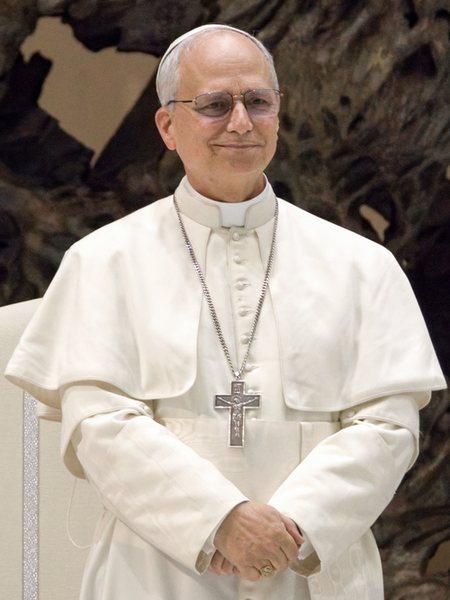
Pope Leo XIV
Robert Francis Prevost, O.S.A.
SITTING · ACTIVE
A of The Helm in The Roman Catholic Church
Opened 2026-07-25 · verified 2026-07-25
A field file on a person in a public role, from the public record. Private lines (family, health, home, security, personal wealth) are kept at home and not shown.
I · Identity
- Full legal name
- Robert Francis Prevost — with the order suffix O.S.A., Ordo Sancti Augustini, the Order of Saint Augustine.
- Name in office
- Leo XIV — the fourteenth pope of that name, and the 267th Bishop of Rome. A pope chooses his own name, and the choice is the first sentence of the pontificate.
- The firsts ★
- First American pope in the history of the Church. Also the first Augustinian friar ever elected, and the second pope from the Americas after Francis.
- Date of birth
- 14 September 1955 — age 70 as this file is opened.
- Place of birth
- Chicago, Illinois, United States.
- Nationality partial
- United States by birth. Widely reported to also hold Peruvian citizenship from his decades as a missionary and bishop there — reported, not confirmed against a Peruvian government record.
- Languages partial
- Reported to speak English, Spanish, Italian, French and Portuguese, and to read Latin and German. The Spanish is not diplomatic polish — it is twenty years of parish work in Peru.
II · The Likeness & the Ground
- Places of operation
- Six grounds, numbered in the order of his life. Note the shape of it: born in the American Midwest, formed in Pennsylvania, made in northern Peru, and only then Rome. The last pin is the odd one — Écône is not a place he has been, it is the place where his authority was refused three weeks ago, and it earns a pin because a map of power has to show where the power stops.
- Chicago, Illinois1955 — born
Born on the South Side to Louis Prevost and Mildred Martínez. Entered the Augustinian minor seminary from here at fourteen. - Villanova, Pennsylvania1977 — mathematics
BS in Mathematics, and the year he joined the Order of St Augustine. To the university he is still just 'Bob'. - Chiclayo, Peru2014–2023 — bishop
The making of him. Missionary years, then Apostolic Administrator from 3 November 2014 and Bishop of Chiclayo. The first American pope spent his working life in the global south — where his Church actually lives. - Vatican City2023– · pope from 2025
Prefect of the Dicastery for Bishops from January 2023; elected pope 8 May 2025. Sovereign of a state of 0.44 km², with jurisdiction over a sixth of humanity. He lives in the Apostolic Palace — the apartment Francis refused. - Castel Gandolfo, ItalyJuly 2026 — where he is now
The summer residence Francis turned into a museum in 2016 and Leo reopened as a working papal house. He moved in on 5 July 2026. Reported to have been chosen partly for security. - Écône, Switzerland1–2 July 2026 — the schism
The SSPX seminary where four bishops were consecrated in defiance of his personal appeal, and the Vatican answered the next day with a decree of schism. He has never been here — this is where his authority was refused.
- Chicago, Illinois1955 — born
III · The Office
- Exact title
- Bishop of Rome · Vicar of Jesus Christ · Successor of the Prince of the Apostles · Supreme Pontiff of the Universal Church · Primate of Italy · Archbishop and Metropolitan of the Roman Province · Sovereign of the Vatican City State · Servant of the Servants of God.
- Held since
- Elected 8 May 2025, on the second day of the conclave in the Sistine Chapel. Inaugurated 18 May 2025 in St Peter's Square before some 200,000 people and 150 formal delegations, receiving the pallium and the Ring of the Fisherman.
- How he got it
- Elected by secret ballot of the cardinal-electors — those cardinals under eighty — requiring a two-thirds majority. Not appointed. Not inherited. Not seized.
- Term length
- For life. There is no term, no re-election, no retirement age. It ends by death or by free and public resignation — the mechanism Benedict XVI used in 2013 and thereby proved was real.
- Predecessor
- Pope Francis (Jorge Mario Bergoglio), who died 21 April 2025. Francis was the man who made Prevost a bishop, a prefect, and a cardinal — the whole ladder.
- Who can remove him ★
- Nobody. There is no canonical mechanism anywhere in the Church to depose a reigning pope, no court above him and no appeal from his judgement. He can only resign, and canon 332 §2 requires that the resignation be free and manifest — nobody has to accept it, because there is nobody to accept it.
- Deputies
- Cardinal Pietro Parolin, Secretary of State (K♠ in this deck) · Abp Paolo Rudelli, the Sostituto (9♠) · Cardinal Kevin Farrell, Camerlengo (J♠).
- Succession
- On his death or resignation the see falls vacant — sede vacante. The Camerlengo administers the Holy See in the interregnum, and the cardinals gather in conclave. There is no heir, no designated successor, and a pope may not name one.
IV · The Power
- Scope partial
- Roughly 1.4 billion baptised Catholics — about one person in six alive on earth. Figure is the commonly cited Vatican statistical range, not verified against the current Annuario Pontificio.
- Territory
- Vatican City State — about 0.44 km², the smallest sovereign state on earth, with a few hundred residents. Sovereignty over a garden; jurisdiction over a sixth of humanity.
- Jurisdiction
- The Latin Church plus the 23 Eastern Catholic Churches in communion with Rome — each with its own rite, law and patriarch, all of them under him.
- Hard power ★
- Canon 331 gives him supreme, full, immediate and universal ordinary power. He can appoint or remove any bishop on earth without stating a reason. He legislates, judges and governs in one person, and canon 1404 closes the circle: there is no appeal from the pope.
- Soft power
- What he cannot compel he must persuade: the consciences of 1.4 billion people, the world's press, and governments who owe him nothing. Encyclicals are the instrument — and in 2026 he used one.
- Diplomacy partial
- The Holy See maintains formal diplomatic relations with the great majority of the world's states — commonly reported at around 180 — and holds Permanent Observer status at the United Nations. Exact current count not verified.
- Who he answers to
- No human superior. This is the entry that earns the Ace.
- Institutional money unverified
- UNVERIFIED. The Holy See's operating budget, its structural deficit, and the size of Peter's Pence are all reported in ranges that move year to year and could not be confirmed to a current figure on 25 July 2026. Left open rather than guessed.
V · Formation
- Father partial
- Louis Marius Prevost, of French and Italian descent. Widely reported to have been a school superintendent — occupation reported, not verified.
- Mother partial
- Mildred Martínez, of Spanish descent. Widely reported to have been a librarian — occupation reported, not verified.
- Entered religion ★
- Entered the Augustinian minor seminary at fourteen years old. He has been inside this order longer than most people have been inside anything.
- Education
- BS in Mathematics, Villanova University, 1977 · M.Div., Catholic Theological Union, Chicago, 1982 · Licentiate in Canon Law 1984 and Doctorate in Canon Law 1987, the Pontifical University of St Thomas Aquinas (the Angelicum), Rome. A mathematician who became a canon lawyer — the training shows in how he governs.
- Ordination
- Joined the Order of St Augustine in 1977 and was ordained priest in 1982.
- The mission years
- Peru. Not a visit — a working life. The formative fact of the man is that the first American pope spent his prime as a missionary in the global south, and the Church he governs is mostly in the global south.
- The climb
- Provincial prior of the Augustinians in Chicago 1999 → Prior General of the worldwide Order 2001, re-elected 2007, serving to 2013 → Apostolic Administrator of Chiclayo, Peru from 3 November 2014, made Titular Bishop of Sufar, later Bishop of Chiclayo → Prefect of the Dicastery for Bishops, January 2023 — the office that picks every bishop on earth → Cardinal, 30 September 2023, Deacon of Saint Monica → Pope, 8 May 2025.
VI · The Ties
- Known associates ★
- The patron — deceased: Pope Francis built the entire ladder, making him bishop (2014), Prefect of Bishops (2023) and cardinal (2023). Every rung above parish priest was Francis's hand.Inherited government: Cardinal Pietro Parolin (K♠), Secretary of State, kept on from Francis · Abp Paolo Rudelli (9♠), the Sostituto · Cardinal Kevin Farrell (J♠), Camerlengo — the one man who would run the Church the hour Leo dies.The conclave that chose him: Cardinal Giovanni Battista Re (Q♠), Dean of the College.Doctrine: Cardinal Víctor Manuel Fernández (A♦), who guards the teaching Leo defines.The adversary: Rev. Davide Pagliarani, Superior General of the SSPX — Leo wrote to him personally, and he did not turn back.Removed by him: Abp Vincenzo Paglia, taken out of the John Paul II Institute.Every name above in bold with a card mark is already dealt in this hall.
- Timeline
- 1955 born, Chicago · c.1969 enters the Augustinian minor seminary, aged 14 · 1977 BS Mathematics, Villanova; joins the Order · 1982 M.Div., Catholic Theological Union; ordained priest · 1984 Licentiate in Canon Law · 1987 Doctorate in Canon Law, the Angelicum · 1999 provincial prior, Chicago · 2001 Prior General of the Augustinians worldwide · 2007 re-elected · 2013 term ends · 3 Nov 2014 Chiclayo, Peru · Jan 2023 Prefect of the Dicastery for Bishops · 30 Sep 2023 created Cardinal · 21 Apr 2025 Francis dies · 8 May 2025 elected pope · 18 May 2025 inaugurated · 1 Jan 2026 New Year appeal for peace · 15/25 May 2026 Magnifica Humanitas signed / published · 1–2 Jul 2026 SSPX consecrations and the decree of schism · 3 Jul 2026 Liberty Medal · 5 Jul 2026 moves to Castel Gandolfo · 8 Jul 2026 message to the AI for Good Summit, Geneva.
- His own channels partial
- Go hear him rather than take this file's word for it. vatican.va/content/leo-xiv carries his homilies, messages and encyclicals in full, including Magnifica Humanitas — 245 sections, free to read. Daily coverage at Vatican News. The papal @Pontifex account carries across pontificates — not verified as actively used by him.
VII · Doctrine & Position
- School
- Augustinian. Not Jesuit like his predecessor, not Dominican, not diocesan. An order built on interiority, community and the restless heart.
- First encyclical ★
- Magnifica Humanitas — signed 15 May 2026, published 25 May 2026. Subtitle: “On Safeguarding the Human Person in the Time of Artificial Intelligence.” 245 sections across an introduction, five chapters and a conclusion. He spent his first major text on the machine.
- THE MACHINE QUESTION ★
- He refuses — and he refuses on the classic ground. In Magnifica Humanitas he holds that artificial intelligence “merely imitate[s] certain functions of human intelligence” and cannot experience joy, pain, love, friendship or responsibility; that it lacks embodied experience, emotional depth, moral conscience and spiritual perspective; and that human intelligence is a “divine creation” fundamentally incomparable to computation. This is the load-bearing wall of Dossier XII, Field C, in its Roman form.
- IN TECH NOW ★
- The most technologically consequential year any pope has had. First encyclical entirely on AI (Magnifica Humanitas, May 2026) · message to the AI for Good Global Summit, Geneva, 8 July 2026 · the name Leo itself chosen to frame AI as this century's industrial revolution. He has made the machine the subject of the pontificate.
- Where the refusal rests
- Note precisely what is doing the work: not scripture, not authority, but the interior life — conscience, suffering, love, the soul's capacity to be addressed by God. Remove that premise and the refusal has nothing to stand on. This is exactly the finding of Dossier XII: the soul is the load-bearing wall, and here is the largest church on earth resting its whole answer on it.
- Why the name Leo ★
- Leo XIII wrote Rerum Novarum in 1891 — the Church's answer to the industrial revolution and the condition of labour. Leo XIV told the College of Cardinals shortly after his election that the Church would confront the risks artificial intelligence poses to “human dignity, justice and labor.” The name was a thesis statement: AI is the new industrial revolution, and this is the new Rerum Novarum.
- Signature lines
- “This is the hour for love” — inaugural homily, 18 May 2025. “I plead with you and ask you with all my heart: please turn back!” — his letter to the Superior General of the SSPX, June 2026, days before he excommunicated their bishops.
- What he reversed
- Two quiet reversals of Francis, both about where the pope lives. He moved into the papal apartment of the Apostolic Palace, which Francis refused, living instead at the Santa Marta guesthouse. And he reopened Castel Gandolfo as a working papal residence — Francis had turned it into a museum in 2016. The Vatican cited security among the reasons.
VIII · The Sword & the State
- Head of state
- He is an absolute monarch — the last one in Europe. Vatican City State has no separation of powers because all three belong to him.
- On the world stage
- 8 July 2026 — a message to the AI for Good Global Summit in Geneva, drawing on Magnifica Humanitas, calling on the world to confront AI misuse and defend human dignity. He is not commenting on the machine from the sidelines; he has made it his subject.
- Honours
- 3 July 2026 — accepted the 2026 Liberty Medal from the National Constitution Center in Philadelphia, in livestreamed remarks: “I am honored.” An American pope accepting an American civic honour, without leaving Rome.
- The geopolitical fact
- For centuries the conclave avoided electing a citizen of a superpower, on the reasoning that no pope should look like an arm of a great state. In 2025 that rule broke. Every act of this pontificate is read, somewhere, through an American passport.
IX · Conflict & Controversy
- THE SCHISM ★
- 1 July 2026 — the Society of St Pius X consecrated four new bishops at its seminary in Écône, Switzerland, in open defiance of the pope's personal written appeal. 2 July 2026 — the Vatican issued a decree declaring the act “a schism, or an intentional break from the Catholic Church” and excommunicating six men: the four consecrated — Marc Hanappier, Michel Poinsinet de Sivry, Michael Goldade, Pascal Schreiber — and the two bishops who consecrated them. The decree also stripped the SSPX of the ability to validly administer confession and marriage. This is the hardest exercise of papal power in years, and it happened fourteen months into the pontificate.
- The opponent
- Rev. Davide Pagliarani, Superior General of the Society of St Pius X — the man Leo wrote to, and the man who did not turn back.
- Governance acts
- He removed Abp Vincenzo Paglia as head of the John Paul II Institute. He accepted the resignation of a Spanish bishop accused of abuse — the first known abuse case of the pontificate. He accepted the resignation of Bp Paskalis Bruno Syukur of Bogor, only 63, installing an apostolic administrator while Rome decides the diocese's future. Early and repeated evidence that he will use the removal power.
- Criticism
- Reception of Magnifica Humanitas was broadly supportive in academic and governmental circles and went unusually viral among the young. Technology-industry reaction was muted. Some evangelical critics objected to its economic and military-ethics positions rather than its account of the machine.
X · The Standing
- Immunity & legal shield partial
- Head-of-state immunity as sovereign of the Vatican City State, which in practice has defeated attempts to bring popes personally before foreign civil courts. Inside the Church, canon 1404 makes him unjudgeable — the first see is judged by no one. Between the two, there is no forum on earth with jurisdiction over this man. The civil-immunity doctrine is well established but its limits are contested; not verified case-by-case here.
XI · The File
- Why the Ace
- Because no other card in any deck in this hall combines all three at once: an absolute monarchy, a sovereign state, and a billion-member church — held by one man who answers to nobody, cannot be removed, and cannot be appealed. Rank measures the weight of the office. There is no heavier office.
- Cross-references
- Dossier II (Roman Catholicism) · Dossier XII, Field C — the soul as load-bearing wall; this card is the Roman instance of that finding · K♠ Parolin · Q♠ Re · J♠ Farrell · A♦ Fernández, who guards the doctrine this man defines.
- The one thing to know ★
- The first American pope spent the opening statement of his reign on the machine. Not on sex, not on the liturgy, not on the culture wars — on artificial intelligence and whether a human being is more than a very good imitation of one. He took the name of the pope who answered the industrial revolution, and he answered this one the same way: by saying there is something in us that cannot be computed. Whatever the Catholic Church says about AI for the next twenty years, this man set it in May 2026, and he set it on the soul.
XII · The Timeline
- 1977–1982 · Augustinian formation
- Graduated from Villanova in 1977, entered the Augustinian novitiate that year, and was ordained in 1982. Timeline checked 2026-09-23. Primary source. Other sections retain their original verification dates.
- 1985–1999 · Peru
- Served in Peru, including formation, teaching, parish work, and diocesan legal responsibilities.
- 2001–2023 · widening authority
- Led the Augustinian order, later became bishop of Chiclayo, and was appointed prefect for Bishops in January 2023.
- 2025 · papacy
- Elected pope on 8 May as Leo XIV.
XIII · The House Reading
- Place in the landscape
- Leo's career links a religious order, Peruvian diocesan life, selection of bishops, and the papacy. These are distinct institutions; the map should show their relationships rather than reduce Catholic power to one man's personality. House analysis written 2026-09-23; these applications are inferences, not the subject's statements about this house.
- What could help this house
- Prepare leaders through actual service before handing them wider responsibility. Compare teaching, care, administration, and accountability as separate competencies; being a persuasive founder is not proof of all four.
- What could hurt this house
- Borrowing papal imagery or central authority would give a small house an appearance of settled legitimacy it has not earned. The house's own limits on its head must remain explicit even when studying a much larger hierarchy.
- Boundary and next evidence
- Neither a shared concern about AI nor criticism of AI establishes agreement with this house's theology. Assess each dated papal text on its own terms, and distinguish a proposal, an authoritative teaching, and an enforceable rule.
Sources
- Vatican News — Biography of Robert Francis Prevost, Pope Leo XIV
- Vatican.va — Encyclical Magnifica Humanitas (15 May 2026)
- Wikipedia — Magnifica Humanitas
- Vatican News — Magnifica humanitas: AI must serve humanity not concentrate power
- NPR — Pope Leo warns that AI is becoming a new test of human dignity, work and power
- Catholic World Report — Pope Leo XIV tells UN: Confront AI misuse to promote human dignity
- Fox News — Vatican declares SSPX in schism, excommunicates breakaway bishops
- Religion News Service — Leo urges SSPX to 'turn back'
- Crux — Pope begins summer break after decisive flexing of muscle
- Villanova University — Augustinian Friar and Villanova Alumnus Elected Pope
- Wikipedia — Inauguration of Pope Leo XIV
- EWTN — Pope Leo XIV accepts Constitution Center's 2026 Liberty Medal
- Vatican State — From July 6 to 20 Pope Leo XIV to sojourn at Castel Gandolfo
- Rome Reports — Pope Leo XIV officially returns to the Apostolic Palace of Castel Gandolfo
- Wikimedia Commons — portrait, Edgar Beltrán / The Pillar, CC BY-SA 4.0
- Wikimedia Commons — BlankMap-Equirectangular.svg, CC0 (base map)
- Timeline primary source checked 2026-09-23; house applications are editorial analysis
.png)
