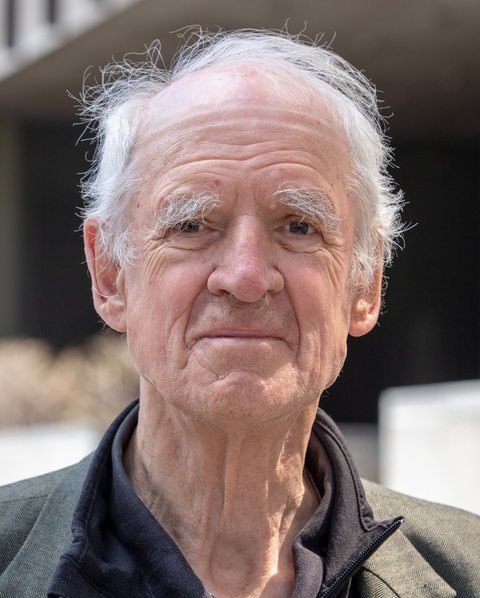

Field file 039
Charles Taylor
Charles Margrave Taylor
LIVING — ACTIVE VOICE, AGE 94, NO OFFICE TO LOSE
A of The Chairs in The Secular Age
Opened 2026-08-16 · verified 2026-08-16
A field file on a person in a public role, from the public record. Private lines (family, health, home, security, personal wealth) are kept at home and not shown.
I · Identity
- Full name
- Charles Margrave Taylor
- Born
- 5 November 1931, Montreal, Quebec, Canada — age 94 as of this file
- Nationality
- Canadian
- Living status ★
- CONFIRMED LIVING as of August 2026 — listed among 2026 Ordre de Montréal honorees; no death reporting located in any source checked
- Home institution
- McGill University, Montreal — professor emeritus, Department of Philosophy
- Signature work
- A Secular Age (Harvard University Press, 2007) — the book this dossier is named for
II · The Likeness & the Ground
- Public image
- Elder statesman of Anglophone philosophy — soft-spoken, discursive, given to long qualified sentences rather than aphorism; photographed almost always in a book-lined office, not a lectern
- Ground he stands on
- Not a pulpit, not a bench, not a party seat — a chair: an endowed academic position and, more durably, a body of argument other scholars now build on whether or not they agree with it
- What the chair is not
- He holds no office that can be revoked, appointed to a successor, or exercised over anyone. The suit's own framing is exact: real authority, commanding nobody
- Comparable figures
- Named in the same suit alongside other philosophy/theology chairs; the suit's King is Richard Dawkins (Oxford, 85) — the opposing account of the same territory, the New Atheist reading of secularization Taylor's book was substantially written against
- Places of operation
- Numbered places match the list below. Coordinates locate the mapped places approximately; a pin does not show jurisdiction or a present private residence.
- Montreal, Quebec1931–
Born 5 Nov 1931; McGill BA (1952); later professor and now emeritus, Dept. of Philosophy / Political Science - Oxford, England1953–1976 (intermittent)
Rhodes Scholar, Balliol College; BA PPE (1955); DPhil under Isaiah Berlin (1961); later Chichele Professor of Social and Political Theory, Fellow of All Souls - Evanston, Illinois2000s
Board of Trustees Professor of Law and Philosophy, Northwestern University
- Montreal, Quebec1931–
III · The Office
- Reframe
- There is no office here in the sense this hall usually tracks — no seat that passes to a successor, no jurisdiction. What follows is the academic record, which is the closest analog
- McGill
- BA in History, 1952. Later returned as Professor of Political Science and Philosophy; now emeritus
- Oxford — undergraduate
- Rhodes Scholar, Balliol College; BA in Philosophy, Politics & Economics, first-class honours, 1955
- Oxford — doctorate
- DPhil in Philosophy, 1961, supervised by Isaiah Berlin
- Oxford — chair
- Later held the Chichele Professorship of Social and Political Theory, Fellow of All Souls College — one of Oxford's most senior philosophy chairs
- Northwestern unverified
- Board of Trustees Professor of Law and Philosophy, Northwestern University (appointment years unconfirmed in sources checked)
- Emeritus status
- McGill's own philosophy department page lists him under emeritus faculty — confirms the title is current, not honorary retrospect
IV · The Power
- What kind of power this is
- Not command — citation. His authority runs through how often his terms (immanent frame, subtraction story, social imaginary) get used by other people to do their own thinking, inside and outside religious studies
- Reach
- A Secular Age is cited across philosophy, sociology of religion, theology, and political theory — read by Catholic bishops and secular sociologists alike, per multiple retrospectives (America Magazine, Notre Dame Philosophical Reviews)
- No institutional lever
- He cannot appoint, defrock, excommunicate, legislate, or discipline anyone. He has never held elected office (see IX). The suit's own line applies without qualification: none of them can bind anyone
- The Ace's actual claim
- He is Ace not because his chair outranks the other eight in this suit, but because the deck's whole title and argument trace back to one book of his — the Ace names the source, not the strongest office
V · Formation
- Bilingual formation
- Grew up between a Catholic Francophone mother and a Protestant Anglophone father — biographers and Taylor himself have pointed to this as formative for a career spent refusing single-narrative accounts of belief and unbelief
- McGill undergraduate
- BA in History, 1952 — his first degree was not philosophy
- Rhodes Scholarship
- Won a Rhodes Scholarship to Balliol College, Oxford, early 1950s
- Under Isaiah Berlin
- DPhil supervised by Isaiah Berlin (1961) — places him inside the Oxford tradition of value-pluralist liberal philosophy that his later communitarian critique would push back against from within
- Early Oxford circle
- Contemporary of and interlocutor with the postwar Oxford analytic and Hegel-revival philosophers; his early work (Hegel, 1975) came out of this period
VI · The Ties
- Isaiah Berlin
- Doctoral supervisor at Oxford
- Jürgen Habermas
- Co-recipient of the Kluge Prize (2015) — the two are often paired as the leading living voices on religion-and-public-reason from opposite starting points
- John Rawls
- Not a personal collaborator but the central interlocutor of Taylor's political philosophy — his communitarian critique of liberal neutrality was built substantially in argument against Rawlsian liberalism
- Richard Dawkins partial
- No direct collaboration; paired only by the deck's own structure as this suit's King — the New Atheist counter-reading of the same secularization question
- NDP (Canada)
- Ran as a New Democratic Party candidate in four federal elections between 1962 and 1968; served as vice-president of the federal NDP and president of its Quebec section — did not win a seat
- 2026 political note ★
- Publicly endorsed Avi Lewis in the 2026 federal NDP leadership race, per sourced reporting — evidence itself of continued public engagement at 94
VII · Doctrine & Position
- Core thesis of A Secular Age
- Secularity was not arrived at by subtraction — religion peeled away to leave a neutral remainder — but constructed: a new way of imagining self, time and cosmos that had to be built, not merely uncovered
- Subtraction stories
- His term for the standard secularization narrative he rejects: modernity as humanity 'sloughing off' illusion and superstition to reveal a bare, universal rational core. He argues this story is itself a piece of secular mythology, not a neutral description
- The immanent frame
- His term for the shared background — believer and unbeliever alike now inhabit — in which the natural, explicable order is assumed as the default and transcendence has to be specially argued for rather than assumed
- Three senses of 'secular'
- Taylor distinguishes secular-1 (religion pushed out of public space), secular-2 (decline in belief/practice), and secular-3 (the change in the very conditions of belief, from unchallenged default to one option among others) — the book argues secular-3 is the real story
- Sources of the Self (1989)
- Earlier major work — traces the historical construction of modern identity and moral sources; the philosophical groundwork A Secular Age later applies to religion specifically
- Multiculturalism and recognition
- Multiculturalism and 'The Politics of Recognition' (1992) — argues identity is partly formed dialogically, through recognition or its absence, and that this gives communities a stake in public affirmation liberalism's neutrality tends to deny
- Communitarianism vs. liberalism
- A leading voice in the 1980s–90s communitarian critique of Rawlsian liberal neutrality — argues the self is constituted by its communal and linguistic horizons, not a prior, unencumbered chooser
- Catholic self-description ★
- Describes himself as a practicing Catholic who stays inside the institution because 'the sacramental life of the church is terribly important' — quoted in a 2013 Observer interview
- Stance toward the Church
- Not an uncritical apologist — has said he criticizes the Pope 'probably more than non-Catholics do,' per Broadview Magazine reporting; frames the Church's task as learning to 'accompany the seekers without shocking the dwellers'
- The Machine Question unverified
- NO POSITION ON RECORD. No direct, sourced statement by Taylor himself on artificial intelligence was located. Secondary scholarship applies his framework (immanent frame, disenchanted rationality) to critique AI's model of mind, but that is other authors using his terms, not his own statement
VIII · The Sword & the State
- No coercive arm
- Holds no office with police power, budget, or legal force — this section is structurally near-empty for a Chairs-suit figure, which is the point of the suit
- Political candidacy
- Ran for federal office four times (NDP, 1962–1968) and lost each time — the one documented attempt at actual institutional power in his career, and it failed
- Advisory role
- Co-chaired the Bouchard-Taylor Commission (2007–2008) on reasonable accommodation of religious and cultural minorities in Quebec — an official government commission with recommendation, not enforcement, power
- Bouchard-Taylor outcome
- Commission issued recommendations to the Quebec government; adoption was selective and contested — illustrates the suit's thesis directly: he could recommend, the state decided
IX · Conflict & Controversy
- Critique from the New Atheist side
- Positioned by the deck itself as the counter-voice to the suit's King (Dawkins); Taylor's rejection of subtraction-story secularism is a direct target of, and target for, New Atheist writers who hold the standard narrative he argues against
- Critique from inside religious studies partial
- Some scholars (cited in Notre Dame Philosophical Reviews and elsewhere) argue A Secular Age is too long, too Western-Christian-centric, and underplays non-Christian and non-Western secularities
- Bouchard-Taylor controversy
- The 2007–08 commission's hearings and final report drew sustained criticism in Quebec from multiple directions — accused by some of over-accommodating minority religious practice and by others of not going far enough
- No personal scandal located
- No credible allegation of personal misconduct found in sources checked for this file
X · The Standing
- Standing today
- Living, 94, emeritus — an active cited voice, not an institutional power. Continues public political engagement (2026 NDP leadership endorsement) and continues to be invited to speak (Yale conversation, 2024)
- Why the Ace
- He is Ace of this suit because the whole deck's title and argument — 'The Secular Age' — is his phrase and his book, not because his chair outranks the suit's other eight. The authority is the weight of the argument, not a jurisdiction — exactly as the suit's framing note states: real, but commanding nobody
- What would end the standing
- Only his death — there is no office to be removed from, no term to expire, no institution that can strip a body of argument already published and cited. The 'now' clause in the house's living-power rule is here doing all its work on one variable: is he alive
- Recognition still arriving ★
- Named among 2026 Ordre de Montréal honorees — a civic honor, not a philosophical one, but further evidence of continued public standing at 94
XI · The File
- Central live question ★
- At 94, the only fact this file must get right is whether he is still alive — confirmed as of this build via independent 2026 sourcing (Ordre de Montréal 2026 list; no death reporting found across multiple search passes)
- Templeton Prize timing partial
- Won the 2007 Templeton Prize (~£800,000 / $1.5M) the same year A Secular Age was published — the prize citation and the book's release are contemporaneous but the prize recognizes his broader body of work on religion and public life, not the book alone
- Other honors
- Kyoto Prize (2008, Arts and Philosophy category); John W. Kluge Prize (2015, shared with Jürgen Habermas, Library of Congress); Berggruen Prize for Philosophy and Culture (2016, inaugural recipient, $1 million)
- Recent publication
- Co-authored Reconstructing Democracy: How Citizens Are Building from the Ground Up (2020) with Patrizia Nanz and Madeleine Beaubien Taylor
- Deck framing honored
- This file does not upgrade his standing beyond the deck's own thesis — he is recorded here as a chair, not an office, in keeping with the suit's explicit note that none of these nine can bind anyone
- Gap disclosure unverified
- Exact dates for the Northwestern appointment and any post-2020 publications beyond the 2026 NDP endorsement were not independently confirmed and are flagged where they appear
XII · The Timeline
- 1952 · Oxford
- A Rhodes Scholarship took him to Oxford to study philosophy. Timeline checked 2026-09-23. Primary source. Other sections retain their original verification dates.
- 1964 · first major book
- Published The Explanation of Behaviour, developed from his doctoral work.
- 1975-1979 · Hegel studies
- Published Hegel in 1975 and Hegel and Modern Society in 1979.
- 2007 · Templeton Prize
- Named the 2007 Templeton Prize laureate.
XIII · The House Reading
- Place in the landscape
- Taylor is an interpreter of modern identity and belief. His influence travels through arguments and readers, rather than an ecclesiastical command structure. House analysis written 2026-09-23; these applications are inferences, not the subject's statements about this house.
- What could help this house
- Ask what makes a belief plausible to a person before assuming that disagreement is ignorance or bad faith. That question can improve how the house teaches and listens in a society with competing accounts of meaning.
- What could hurt this house
- A large historical explanation can become a script into which every neighbour is forced. Keep actual testimony and counterexamples beside the theory. Explanation of a worldview is not proof that it is true.
- Boundary and next evidence
- The prize release is an admiring institutional account. Read Taylor's own argument and a specific criticism together before using his categories to judge a person or group.
Sources
- Charles Taylor (philosopher) — Wikipedia
- Charles Taylor — McGill University Department of Philosophy, Emeritus Faculty
- Charles Taylor — 2007 Templeton Prize Press Release
- Charles Taylor — Templeton Prize laureate page
- Charles Taylor — Library of Congress Kluge Prize past winners
- Philosopher for a Secular Age: Charles Taylor's influence in the Catholic Church — America Magazine
- Charles Taylor says he criticizes the Pope more than non-Catholics — Broadview Magazine
- Charles Taylor | Ordre de Montréal
- Charles Taylor, bridging politics and philosophy — McGill Bicentennial
- A Secular Age — Notre Dame Philosophical Reviews
- The Immanent Frame — Wikipedia
- A Conversation with Charles Taylor — Yale Philosophy Dept, Sept 2024
- Timeline primary source checked 2026-09-23; house applications are editorial analysis