
Field file 033
Bharati Tirtha
Seetharama Anjaneyalu (pre-sanyasa name)
SITTING SHANKARACHARYA OF SHRINGERI — LIVING, AGE 75, SUCCESSOR ALREADY NAMED
A of The Seats in Hinduism
Opened 2026-08-16 · verified 2026-08-16
A field file on a person in a public role, from the public record. Private lines (family, health, home, security, personal wealth) are kept at home and not shown.
I · Identity
- Born partial
- April 3, 1951 (some peetham material gives April 11, 1951 — the two dates disagree by a week and neither source resolves it)
- Birth name
- Seetharama Anjaneyalu, given by his parents; the long-awaited son after four daughters
- Birthplace
- Alugumallepadu village, Dachepalli / Palnadu area, Guntur District, Andhra Pradesh (then Madras State)
- Age now
- 75 as of this file (turned 75 in April 2026) — the central fact this card exists to track
- Sanyasa name
- On monastic ordination he took the title Yogapatta Sri Bharati Tirtha, the name under which he now holds the office
- Current title
- Jagadguru Shankaracharya, 36th in the Sringeri lineage; devotional honorific Sri Sri Sri Bharati Tirtha Mahaswamiji
II · The Likeness & the Ground
- Public image
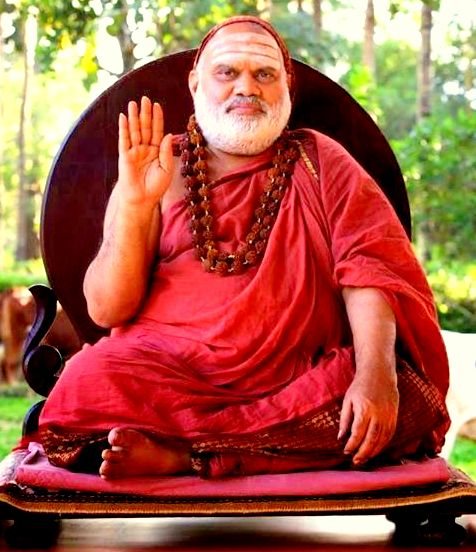
- Almost always photographed seated, in ochre robes, with the wooden danda (staff) of a paramahamsa sanyasi — the visual grammar is stillness and asceticism, not oratory or crowds
- The math itself
- The Sringeri Sharada Peetham sits on the banks of the Tunga River, Chikmagalur district, Karnataka — a temple-monastery complex, not a personal residence; the office outlives any one occupant by design
- Iconography
- The seat's founding claim runs back to Adi Shankara himself in the 8th century — the peetham markets continuity of an unbroken teaching line, not innovation
- Places of operation
- Numbered places match the list below. Coordinates locate the mapped places approximately; a pin does not show jurisdiction or a present private residence.
- Alugumallepadu, Guntur District, Andhra Pradesh1951
birthplace, as Seetharama Anjaneyalu, into a Telugu Smartha family of Vedic scholars - Ujjain, Madhya Pradesh1966
at 15, approached his guru Abhinava Vidyatirtha while the latter was touring; accepted as disciple - Sringeri Sharada Peetham, Karnataka1974–present
took sanyasa 1974; ascended as 36th Jagadguru in 1989 on his guru's death; seat of the office to this day
- Alugumallepadu, Guntur District, Andhra Pradesh1951
III · The Office
- What he holds
- Head of the southern of the traditional four (in some countings five) Amnaya Peethas Adi Shankara is credited with founding to anchor Advaita Vedanta across India
- The other three
- Dvaraka Sharada Peetham (Gujarat, west), Puri Govardhan Matha (Odisha, east), Jyotirmath (Uttarakhand, north) — each with its own Shankaracharya, and each independently succession-disputed at various points in modern history in a way Sringeri largely has not been
- Scope of authority
- Doctrinal and monastic — Vedic education, Advaita scholarship, temple ritual oversight, sanyasa ordination within the lineage. Not political, legal, or binding on lay Hindus generally
- Ascension
- Became 36th Jagadguru in 1989 on the death (Maha Samadhi) of his guru, Abhinava Vidyatirtha, the 35th pontiff
- Tenure length
- As of this file, ~37 years in office — one of the longer-serving heads in the lineage's modern era
IV · The Power
- Nature of the power
- Revered, not commanded. This is the deck's own framing and it holds: Bharati Tirtha can teach, ordain monks, rule on questions of scriptural and ritual practice within his own institution, and be sought as a spiritual authority — but he issues no enforceable law and governs no state
- Contrast with a state office
- Where a president or minister commands agencies, budgets, and coercive force, a Shankaracharya commands only the willingness of the devotee to listen. Most Hindus, across a vast and doctrinally diverse tradition, will never take direct instruction from any Shankaracharya, let alone this one specifically
- Where it actually lands
- His practical reach is concentrated among Smartha Brahmin communities, Sanskrit/Vedic scholarly circles, and institutions (temples, Veda patashalas) formally affiliated with the Sringeri math — a real but bounded constituency, not a national one
- Scholarly authority
- Within Advaita Vedanta specifically his authority is taken more seriously and more widely than his political reach — he is widely regarded among the four peethas as the most scholarly, per the deck's own card text
- Direct educational supervision
- The biography describes him teaching and examining senior Vedic students, beyond appointing teachers. Institutional source.
V · Formation
- Early aptitude
- By age 9, demonstrated command of Sanskrit; participated in All India Radio Sanskrit programmes as a child
- Upanayana
- Sacred-thread ceremony at age 7, per standard Smartha Brahmin practice
- Finding his guru
- At 15, in 1966, left home for Ujjain where Jagadguru Abhinava Vidyatirtha (the 35th pontiff) was touring, and was accepted as a disciple on the spot
- Training
- Under his guru's direct tutelage he completed study of the Krishna Yajur Veda, Purva and Uttara Mimamsa, Nyaya Sastra, and allied treatises within roughly eight years
- Sanyasa
- Formally renounced the world and was ordained a sanyasi on November 11, 1974, taking the name Bharati Tirtha
- Discipleship length
- Remained under his guru's direct guidance for roughly 15 years before the guru's death handed him the seat in 1989
- Languages partial
- Fluent in Sanskrit, Telugu, Tamil, Kannada, and Hindi — reported to converse in Sanskrit more readily than in his mother tongue Telugu
VI · The Ties
- Guru
- Abhinava Vidyatirtha, 35th Jagadguru of Sringeri, died (Maha Samadhi) 1989, transferring the seat
- Designated successor
- Sri Vidhushekhara Bharati, named junior pontiff / successor-designate in 2015 — the office has already answered the succession question in advance, which is unusual among the four peethas and directly relevant to this card's age-risk flag
- Peer seats
- Shankaracharyas of Dvaraka, Puri, and Jyotirmath — formally peers, not superiors or subordinates; no single one of the four outranks the others institutionally
- Institutional network
- Oversees Veda Patashalas (Vedic schools), a manuscript library of roughly 500 palm-leaf texts plus paper holdings, branch maths, and affiliated temples across South India
- Historical patron lineage
- 12th acharya of the math, Vidyaranya, served as ideological advisor to the founders of the Vijayanagara Empire in the 14th century — the seat's political entanglement, where it has existed, is centuries old and not a feature of Bharati Tirtha's own tenure specifically
- River crossing
- Completed his guru’s bridge project: Vidyatirtha Sethu links the two banks of the Tunga at Sringeri. Institutional source.
- Charitable healthcare
- The institutional biography credits him with developing Sharada Dhanvantari Hospital facilities; it does not establish today’s capacity or outcomes. Institutional source.
- Scholar support
- The biography records a lifetime allowance scheme for qualifying Sastra scholars. Its historical amount is not a verified current rate. Institutional source.
- Student support
- The biography describes free meals, textbooks and accommodation for Vedic students: material support alongside religious instruction. Institutional source.
- Pilgrim accommodation
- The biography credits his direction with the Sharada Krupa and Yatri Nivas guesthouses. Institutional source.
- Memorial institution
- He consecrated his guru’s Adhisthanam temple at Narasimhavanam on 12 May 1993. Institutional source.
VII · Doctrine & Position
- School
- Advaita Vedanta — non-dualism, the teaching that the individual self (atman) and ultimate reality (Brahman) are identical, as systematized by Adi Shankara
- Teaching activity
- Personally teaches the Brahma Sutras during the annual Chaturmasya (four-month monsoon retreat) period, and convenes an annual Vidwat Sadas, a scholarly assembly, during the Bhadrapada month
- Reputation within the tradition
- Per the deck's own framing, regarded as the most scholarly and least political of the four peethas' current heads — a reputation this file's research corroborates rather than contradicts
- On AI / technology
- NO POSITION ON RECORD. Targeted search turned up no statement, teaching, or interview from him addressing artificial intelligence or modern technology specifically
VIII · The Sword & the State
- Ram temple consecration, Jan 2024
- The Sringeri math issued a statement encouraging devotees to participate in the Ayodhya Ram temple pran pratishtha, while explicitly denying reports that Bharati Tirtha had expressed displeasure over the event's conduct
- Did not attend personally
- He endorsed the ceremony without committing to attend it himself — a deliberately lighter touch than an outright boycott, but also short of full personal participation
- Contrast with other peethas
- The Shankaracharyas of Puri and Jyotirmath publicly criticized aspects of the same ceremony and declined to attend — Bharati Tirtha's Sringeri notably did not join that criticism, nor did it fully embrace the BJP-aligned framing either
- Misattribution risk flagged
- A widely circulated cow-slaughter and 'is the PM/President even Hindu' statement from 2026 belongs to Avimukteshwaranand Saraswati of Jyotirmath, not to Bharati Tirtha — this file explicitly rules it out to prevent cross-contamination between the four peethas' cards
- Attacks on the Shankaracharya tradition unverified
- A February 2026 open letter from a former CBI director appealed to the Shankaracharyas of Puri, Sringeri, and Dwarka (not, per the letter's own addressing, Bharati Tirtha's seat exclusively) to respond to what the letter characterized as Sangh Parivar pressure on the tradition — sourced from an advocacy site; treat as a claim about the political climate around the seats, not a verified account of Bharati Tirtha's own response
IX · Conflict & Controversy
- No personal scandal on record
- Unlike the Champat Rai case flagged elsewhere in this deck's build notes, no scandal, resignation, or disciplinary matter attaches to Bharati Tirtha personally in the sources checked for this file
- 1791 sacking (historical, pre-dates him)
- Pindari forces looted the Sringeri math following the Third Anglo-Mysore War, damaging temple images and killing Brahmin priests; accounts differ on Tipu Sultan's role (some credit him with sending repair funds, others emphasize later Maratha reconciliation) — a historical episode of the institution, not of this pontiff
- Deliberate non-alignment as its own quiet controversy
- Within Hindu-nationalist commentary circles, Sringeri's refusal to fully embrace BJP-aligned events has itself drawn periodic criticism from that direction — the absence of alignment functions, for some observers, as a position
X · The Standing
- Current status
- Sitting Jagadguru, active in public ritual duty as of the most recent confirmed date in this file (Chaturmasya Vrata Sankalpa, July 29, 2026)
- Institutional insulation
- Because a successor has been named in advance, the office is structurally prepared for succession in a way that reduces (but does not eliminate) the shock a sudden death or incapacity would otherwise cause the seat
- Card placement
- Ace of Spades, The Seats — the highest card in a suit explicitly defined by this deck as revered but non-binding; the placement itself argues that scholarly/traditional standing, not political reach, is what earns the top of this particular suit
XI · The File
- What would trigger a cut
- Any credible report of his death, incapacitating illness, or formal transfer of the seat to Vidhushekhara Bharati. None of those had occurred as of this file's verification date
- THE MACHINE QUESTION
- NO POSITION ON RECORD. No statement on AI, automation, or digital technology was found in the sources checked; this file does not infer one
- What the office is not
- Restated plainly per house rule: this is pontifical, revered, and non-binding — the opposite kind of power from a head of state. He commands no army, passes no law, and cannot compel obedience from the overwhelming majority of Hindus, who will never seek or receive an instruction from him in their lifetime
- Reliability of self-reported material partial
- Biographical detail drawn from the peetham's own site (sringeri.net) is devotee-sourced and reads as hagiography in places (e.g., framing every early achievement as a mark of destined greatness) — treated here as a source for facts (dates, places, titles) but flagged where it shades into characterization
- Open discrepancy unverified
- Birth date is given as April 3, 1951 by Wikipedia and April 11, 1951 by a WebSearch summary of peetham material — this file could not resolve which is correct and reports both rather than silently picking one
XII · The Timeline
- 1966 · training at Ujjain
- Sought and received instruction from Abhinava Vidyatirtha. Timeline checked 2026-09-23. Primary source. Other sections retain their original verification dates.
- 1974 · renunciation
- Was initiated into sannyasa.
- 1990 · bridge completed
- Inaugurated the Vidyatirtha Sethu bridge at Sringeri on 21 May, continuing a project begun by his teacher.
XIII · The House Reading
- Place in the landscape
- This is a Sringeri teaching lineage, with a particular school, place, and succession. Map that scope before generalizing from one teacher to Hindu traditions as a whole. House analysis written 2026-09-23; these applications are inferences, not the subject's statements about this house.
- What could help this house
- The biography joins disciplined study with a practical public project. Pair inherited teaching with work that can be inspected: what was taught, who learned it, and what service was completed?
- What could hurt this house
- A devotional biography describes its teacher in reverential terms. Repeating its praise as an independent finding would make the house's map less reliable. Preserve the difference between a community's belief and a verified event.
- Boundary and next evidence
- Use this source for its account of dates and projects. Claims about spiritual realization belong to the tradition's testimony, and present institutional responsibilities need current records.
Sources
- Sringeri Sharada Peetham — official Jagadguru biography
- Sringeri Sharada Peetham — official site
- Sri Shankara Jayanti Mahotsava 2026 announcement
- Wikipedia — Bharathi Tirtha
- Wikipedia — Sringeri Sharada Peetham
- Wikipedia — Abhinava Vidyatirtha
- OpIndia — 'Sri Bharati Tirtha Mahaswamiji has expressed no displeasure over Pran Pratishtha': Sringeri Math statement
- ThePrint — In spotlight over Ram temple pran pratishtha, the Shankaracharyas & their long tryst with politics
- ThePrint — Shankaracharya who criticised Ram temple event slams BJP over cow slaughter (Avimukteshwaranand Saraswati, Jyotirmath — not Bharati Tirtha)
- Hindu Existence — open letter on Sangh Parivar pressure addressed to Puri, Sringeri & Dwarka Shankaracharyas (advocacy source, unverified)
- Timeline primary source checked 2026-09-23; house applications are editorial analysis