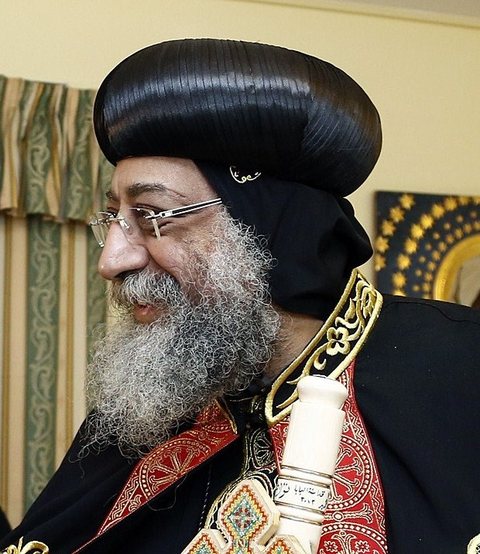

Field file 037
Pope Tawadros II
Wagih Sobhy Baky Soliman
A of The Thrones in Oriental Orthodox
Opened 2026-08-16 · verified 2026-08-16
A field file on a person in a public role, from the public record. Private lines (family, health, home, security, personal wealth) are kept at home and not shown.
I · Identity
- Birth name
- Wagih Sobhy Baky Soliman, born 4 November 1952 in Mansoura, Egypt.
- Monastic name
- Took the name Tawadros (Theodore) on entering monastic life.
- Age
- 73 as of this file's verification date.
- Title in full
- Pope of Alexandria and Patriarch of the See of St. Mark — 118th in the papal succession the Coptic Church traces to the Evangelist Mark.
- Seat
- Canonical seat is Alexandria; the practical administrative centre has been Cairo since the mid-20th century.
- In office since
- Enthroned 18 November 2012, following the death of Pope Shenouda III.
II · The Likeness & the Ground
- Public image
- Presents as a soft-spoken pastoral figure — reserved by comparison with the more overtly political predecessor Shenouda III, though events since 2013 have pulled him into open political alignment.
- Ground partial
- Head of the largest Christian body in the Middle East — Coptic Christians are commonly estimated at roughly 10% of Egypt's population, though the church and the state have long disputed the precise figure and no independent census confirms either side's number.
- Institutional weight
- The Coptic Orthodox Church is the mother church of the Oriental Orthodox communion's largest member and the historic source of autocephaly for two other sees in that communion (Ethiopian, Eritrean).
- Places of operation
- Numbered places match the list below. Coordinates locate the mapped places approximately; a pin does not show jurisdiction or a present private residence.
- Cairo, Egypt2012–present
Papal Residence and administrative seat; Cairo has functioned as the practical centre of the papacy since Pope Cyril VI. - Alexandria, Egyptcanonical seat
Alexandria, the city named in the title Pope of Alexandria and Patriarch of the See of St Mark. The previous map entry incorrectly placed the December 2016 Cairo bombing here. - Wadi El Natrun, Egypt1986–1988
Monastery of St. Pishoy — where he entered monastic life and was ordained a monk in 1988. - Austria · Vienna reference pointlocation detail unverified
Vienna is shown as a broad Austrian reference point. The earlier file describes a January 2026 medical visit, but the precise treatment and monastery locations have not been verified here. - Tanta, Egypt2017
St. George's Church — site of a Palm Sunday 2017 suicide bombing that killed about 27.
- Cairo, Egypt2012–present
III · The Office
- Selection method
- Chosen by a three-stage process unique among the cards in this hall: (1) the Holy Synod and an electoral college of clergy and prominent lay Copts narrow candidates through nomination and voting to a final shortlist (commonly three names); (2) the finalists' names are written on slips of paper, sealed in a glass or crystal vessel, and placed on the altar during the liturgy; (3) a blindfolded child — historically an altar boy between roughly 5 and 8 years old, chosen from a pool the acting head of the church selects — draws one slip, which the presiding bishop reads aloud as the new pope.
- The theology of the draw
- Copts hold the final draw is not a vote but a submission to God's will, modeled explicitly on Acts 1:26 — the apostles casting lots to choose Judas Iscariot's successor, Matthias.
- 2012 selection
- Tawadros was one of three finalists (with Bishop Raphael and Fr. Rafael Ava Mina); his name was drawn on 4 November 2012, his 60th birthday, by a blindfolded boy in Cairo's St. Mark's Cathedral, and he was enthroned two weeks later.
- Canonical authority
- Holds authority as first among equals within the Holy Synod of Coptic bishops rather than as an autocrat — major doctrinal and disciplinary matters formally pass through Synod deliberation, though the papal office carries substantial practical weight in appointments and public representation.
- Term
- Office is for life; there is no retirement mechanism comparable to the Roman Catholic provision for a pope to resign.
- Revising selection rules
- After his election he commissioned revision of the 1957 patriarchal selection regulation; the church records Synod approval in 2014. Institutional source.
IV · The Power
- Direct authority
- Presides over the Holy Synod, ordains and assigns bishops, and is the sole figure empowered to consecrate the holy chrism (myron) used across the church's sacraments.
- Reach partial
- Nominal jurisdiction over an estimated global Coptic population in the range of 10–18 million, concentrated in Egypt with a substantial diaspora in North America, Australia, and Europe; church-cited figures at the higher end are not independently audited.
- Political capital
- Functions as the recognized voice of Egypt's Christian minority in dealings with the state — a role with no formal constitutional standing but heavy practical use by both church and government.
- Financial base unverified
- UNVERIFIED — no independently audited figure for the Coptic Orthodox Church's assets, endowments, or annual budget was found in open sources.
- A documented crisis decision
- The Synod’s Permanent Committee, chaired by Tawadros, ordered church closures on 21 March 2020. Reopening began gradually on 30 August with diocesan discretion. Institutional source.
V · Formation
- Education
- Earned a bachelor's degree in pharmacy from Alexandria University in 1975 — the original professional training, verified across multiple biographical sources.
- Pharmaceutical career
- Worked as a manager at a state-owned pharmaceutical company in Damanhour under Egypt's Ministry of Health before entering religious life; earned a WHO-linked fellowship from a British international health institute in 1985.
- Theological training
- Attended the Coptic Orthodox Theological Seminary, graduating in 1983 — theological study ran concurrently with, and outlasted, the pharmacy career.
- Monastic entry
- Entered the Monastery of St. Pishoy in Wadi El Natrun on 20 August 1986; ordained a monk 31 July 1988, a priest 23 December 1989.
- Episcopal consecration
- Consecrated a general bishop on 15 June 1997 by Pope Shenouda III, assisting Metropolitan Pachomius of Beheira — the post that put him in the church's senior administrative track ahead of 2012.
- Administration studies
- The church’s history records completion of administration and Christian education studies in Singapore in 1999; it does not identify a degree. Institutional source.
- Teaching before the papacy
- Taught New Testament at the theological college in Damanhur and taught at its biblical studies and Coptic hymns/language institutes. Institutional source.
- Children’s service
- Became rapporteur of the Holy Synod’s children’s service committee in 2005, working on conventions, publications and provision for children with disabilities. Institutional source.
VI · The Ties
- The ten thrones, six churches
- The Oriental Orthodox communion comprises six autocephalous churches holding roughly ten patriarchal/catholicate sees between them: Coptic (Egypt), Ethiopian Orthodox Tewahedo, Eritrean Orthodox Tewahedo, Armenian Apostolic (four sees: Etchmiadzin, Cilicia, Jerusalem, Constantinople), Syriac Orthodox, and Malankara (Indian) Orthodox.
- No supreme head
- Unlike Roman Catholicism's single pope, the six churches are hierarchically independent of one another — full sacramental communion, no shared executive.
- Coptic as mother church
- The Coptic see conferred autocephaly on the Ethiopian church in 1959 (under Pope Cyril VI) and the Eritrean church in 1993 (under Pope Shenouda III) — Tawadros inherits a historic patron relationship with both, though both are now fully independent.
- Relations with Rome
- Maintains active ecumenical contact with the Roman Catholic Church; met Pope Francis in Rome in 2023 for the 50th anniversary of the 1973 Joint Christological Declaration, and Francis added 21 Coptic martyrs killed by ISIS in Libya (2015) to the Catholic calendar of saints that year.
- Relations with Constantinople/Eastern Orthodoxy
- Maintains cordial working ties with the Eastern Orthodox patriarchates; no full doctrinal communion exists between the Oriental Orthodox and Eastern Orthodox families, a division dating to the Council of Chalcedon (451 AD).
- World Council of Churches
- The Coptic Church is a WCC member and Tawadros has given public reflections through that body on Coptic heritage and ecumenical standing.
- Training church administrators
- Founded the Coptic Institute for Church Management and Development in 2015. The institute reports his 2018 commission to train newly ordained priests during their initial forty days. Institutional source.
- Papal Projects Office
- Established in October 2013 for education and healthcare. Its institutional account describes schools, refugee education, livelihood projects and clinical services; these are reported activities, not independently audited outcomes. Institutional source.
VII · Doctrine & Position
- Christology
- Holds the Miaphysite position — one united divine-human nature in Christ — the historic Oriental Orthodox position that separated the family from Chalcedonian churches in 451 AD, though 20th-century joint declarations with Rome and the Eastern Orthodox have found the difference to be largely terminological rather than substantive.
- On the 2012–13 constitution
- Publicly and unusually vocally criticized the Morsi-era draft constitution as discriminatory toward Christians — a notably political stance for a newly enthroned pope who had signaled he wanted a lower profile than Shenouda III.
- Jerusalem policy reversal
- Broke Pope Shenouda III's decades-long boycott on Coptic visits to Jerusalem, traveling there in 2015 for a bishop's funeral — a move that divided Coptic opinion, since the boycott had been tied to non-recognition of Israeli control and its violation had previously carried excommunication.
- THE MACHINE QUESTION
- NO POSITION ON RECORD. No statement, sermon excerpt, or interview attributable to Pope Tawadros II on artificial intelligence was found. (Pope Leo XIV of Rome issued a major AI-focused encyclical, Magnifica Humanitas, in May 2026 — no parallel Coptic statement located.)
VIII · The Sword & the State
- The alliance
- Stood publicly beside then-General Abdel Fattah el-Sisi at the July 2013 televised announcement of President Morsi's removal — a moment that has defined his relationship with the state ever since and made him one of Sisi's most visible religious backers.
- December 2016 Cairo bombing
- A suicide bomber struck St. Peter and St. Paul Church, adjoining St. Mark's Cathedral in Cairo, on 11 December 2016, killing at least 25 and wounding 49 — claimed by ISIS.
- April 2017 Palm Sunday bombings
- Twin ISIS suicide bombings struck St. George's Church, Tanta (about 27 killed, 78 wounded) and St. Mark's Cathedral, Alexandria — the papal cathedral itself (at least 16 killed, 41 wounded) on 9 April 2017, killing at least 43 in total — described at the time as the worst single day of anti-Christian violence in modern Egyptian history.
- State response invoked
- Sisi declared a three-month state of emergency after the 2017 bombings and has repeatedly cited church-security measures and reconstruction funding as evidence of state protection for Copts.
- The Church Building Law
- Sisi ratified a new Church Construction Law on 28 September 2016, drafted with input from Egypt's main Christian denominations, easing decades of Ottoman-era restrictions (the 1856 Hamayouni Decree lineage) that had required executive permission for even minor church repairs. Tawadros publicly praised it as correcting "a wrong that lasted for 160 years."
- Church legalization since partial
- Egyptian state sources report more than 2,800 previously unlicensed churches and affiliated buildings legalized under the new law's provisions in its first several years — a state-reported figure, not independently audited.
- New administrative capital
- Sisi directed that a church be built in the new administrative capital east of Cairo as a counterpart to the mosque built there — Tawadros publicly thanked him for the gesture and for directives to include churches in other new urban developments.
- The underside
- Rights groups (e.g., the Egyptian Initiative for Personal Rights) and independent reporting continue to document that sectarian attacks on Copts outside major cities — arson of unlicensed prayer halls, mob actions after disputes — persist at the local level even as the top-level Sisi–Tawadros alliance projects protection; the church's public alignment with the state has drawn some internal criticism for muting dissent on these local incidents.
IX · Conflict & Controversy
- Jerusalem visit backlash (2015)
- His 2015 trip to Jerusalem for Bishop Abraham's funeral broke a boycott his predecessor had enforced with excommunication threats, drawing criticism from Copts who read it as premature normalization absent an Israeli-Palestinian settlement.
- Rumor suppression unverified
- Egyptian and Coptic outlets (e.g., Arab News) reported the church moving to quash unspecified rumors about the severity of his condition during the January 2026 episode — the underlying rumors themselves were not independently substantiated in sources found for this file.
- Return to full duty
- By April 2026 he undertook an 18-day pastoral tour spanning Turkey, Austria, Italy, and Croatia — read by church communications as a deliberate signal of full recovery.
X · The Standing
- Current status
- Sitting and active. Last dated public activity found: an audience with an Egyptian state legal official at the Papal Residence, Cairo, 26 July 2026.
- Succession watch
- No successor process has been initiated and none would be expected while he remains active; at 73 with one recent surgical episode, standard actuarial caution applies but nothing more.
- Net position
- Holds the office at the peak of its modern institutional strength — legalized churches, a state ally, and renewed international travel — while presiding over a community that remains a real target for sectarian and terrorist violence the state has not eliminated, only reduced.
XI · The File
- Cut check result
- PASSED. No death, incapacitation, or succession event found for Pope Tawadros II as of this file's verification date (16 August 2026). Proceeded to full file.
- Confidence note
- Health and political-alliance material is well-sourced through church, Egyptian state, and international outlets; financial and precise-membership figures are church-reported estimates only and are flagged accordingly.
- Open gaps
- No independently audited church budget/asset figure; no verifiable statement from him personally on AI or emerging technology; the specific unverified 2026 rumor content addressed by the church's denial was not itself locatable.
XII · The Timeline
- 1988 · monastic life
- The Coptic Church dates his entry into monasticism to 31 July. Timeline checked 2026-09-23. Primary source. Other sections retain their original verification dates.
- 1997 · episcopate
- The official episcopal record gives 15 June for his episcopate.
- 2012 · patriarchate
- Began his patriarchate on 18 November as Pope of Alexandria and Patriarch of the See of St Mark.
XIII · The House Reading
- Place in the landscape
- Tawadros belongs to the Coptic Orthodox succession. The title pope must be read with its institution: this is the Alexandrian office, not the Roman papacy. House analysis written 2026-09-23; these applications are inferences, not the subject's statements about this house.
- What could help this house
- Study how a community passes on worship, teaching, and service over generations. Give the house's repeated practices an explanation and a record so they do not depend entirely on one person's memory.
- What could hurt this house
- An ancient title can tempt the house to treat age as proof that every present decision is sound. Test a specific teaching or action on its evidence; continuity and accountability must both be visible.
- Boundary and next evidence
- These dates establish stages of office. They do not establish every Copt's political position or personal loyalty. Keep the patriarch, the synod, local clergy, and ordinary members distinct when mapping influence.
Sources
- Coptic Orthodox Church — Statement Regarding the Health Status of H.H. Pope Tawadros II (16 Jan 2026)
- Coptic Orthodox Church — H.H. Pope Tawadros II Arrives Home (24 Jan 2026)
- Coptic Orthodox Church — The Visit of H.H. Pope Tawadros II to Turkey, Austria, Italy, and Croatia (April–May 2026)
- Coptic Orthodox Church — H.H. Pope Tawadros II Receives Counsellor Abdel Nasser Abu El Azm (26 Jul 2026)
- SIS (Egypt State Information Service) — Sisi phones Pope Tawadros II to check on his health following kidney surgery
- Arab News — Egypt church quashes rumors about Pope Tawadros' health
- Coptic Orthodox Church — Pope Tawadros II (official biography)
- Wikipedia — Pope Tawadros II of Alexandria
- Egypt Independent — Tawadros II: The 118th pope of the Coptic Church
- Britannica — Tawadros II
- Ahram Online — 'God's will' and a child to pick Egypt's new Coptic pope: The Altar lottery
- Desiring God — A Coptic Committee, a Blindfolded Boy, and the Hand of God
- CBS News — Bishop Tawadros picked by lottery in Egypt to be new pope of Coptic Christian church
- Wikipedia — Oriental Orthodox Churches
- World Council of Churches — His Holiness Pope Tawadros II reflects on deep heritage, unique roles of Coptic Orthodox Church
- Vatican News — Pope Francis adds 21 Coptic Orthodox martyrs to Catholic list of saints (2023)
- Catholic News Agency — Full text of joint statement by Pope Francis and Tawadros II
- Human Rights Watch — Egypt: Horrific Palm Sunday Bombings (2017)
- Wikipedia — Palm Sunday church bombings
- Open Doors — Egypt: Palm Sunday attacks on Coptic churches kill 45
- EgyptToday — More than 2.8K churches legalized in five years in Egypt
- EgyptToday — Pope Tawadros II thanks President Sisi for building churches in new cities
- Middle East Eye — Egypt's law on building churches dashes Christian hopes for equality
- Egyptian Initiative for Personal Rights — The repercussions of Pope Tawadros' visit to Jerusalem
- Al Jazeera — Jerusalem visit of Egypt's Coptic pope stirs divisions
- Fox News (AP) — Egypt's Coptic Christian pope says Islamist-backed constitution discriminatory
- Al Jazeera — Pope says AI must be 'disarmed' to prevent domination, exclusion, and death (Pope Leo XIV, May 2026)
- Timeline primary source checked 2026-09-23; house applications are editorial analysis
- Coptic Orthodox Church — institutional history, Tawadros section; checked 2026-09-24
- Coptic Institute — foundation, training and Papal Projects Office; checked 2026-09-24