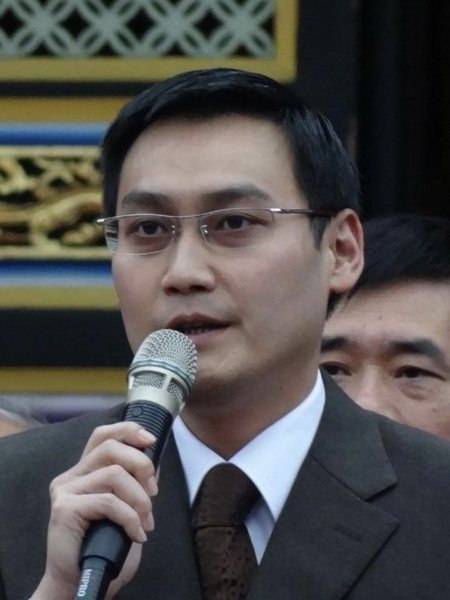

Field file 032
Kung Tsui-chang
Kung Tsui-chang (孔垂長)
INHERITED RITE, NO JURISDICTION — HOLDS THE LINE, NOT THE LAND
A of The Lineages in Confucianism, Taoism & Shinto
Opened 2026-08-16 · verified 2026-08-16
A field file on a person in a public role, from the public record. Private lines (family, health, home, security, personal wealth) are kept at home and not shown.
I · Identity
- Full name
- Kung Tsui-chang (孔垂長). The generation character tsui (垂) marks him as 79th-generation in the direct male line from Confucius; chang (長) reads as "long [history of the family]."
- Born
- 1 July 1975, National Taiwan University Hospital, Taipei.
- Father
- Kung Wei-yi, died 1989 — predeceased his own father, Kung Te-cheng, which is how Tsui-chang inherited the title directly from his grandfather rather than his father.
- Grandfather / predecessor
- Kung Te-cheng, the last Duke Yansheng and 1st Sacrificial Official to Confucius, also a former President of Taiwan's Examination Yuan; died 2008.
- Lineage claim partial
- The Kong family's direct patrilineal descent from Confucius, preserved by primogeniture, is described in scholarly and popular sources as the world's longest continuously recorded family tree — 80-plus generations. Depth this far back rests on the family's own genealogy registry rather than independent documentary verification generation-by-generation.
II · The Likeness & the Ground
- Face unverified
- No detailed physical description sourced beyond photographs accompanying news coverage of official ceremonies; not itemized here.
- Home ground
- Taipei, Taiwan — the office and its ceremonial seat sit in the Taipei Confucius Temple, not in Qufu where the family's ancestral compound and the philosopher's tomb are located.
- The split
- The living bloodline heir sits in Taiwan. The state that has rebuilt Confucius as a pillar of national ideology — official ceremony, textbooks, Confucius Institutes worldwide — is the People's Republic of China, which does not hold the family line.
- Places of operation
- Numbered places match the list below. Coordinates locate the mapped places approximately; a pin does not show jurisdiction or a present private residence.
- Taipei Confucius Temple, Taiwan2009–present
Seat of the office; presides over the annual Shidian sacrificial rites here as Sacrificial Official. - Qufu, Shandong, China2011–present
Ancestral home ground and Confucius Temple/Cemetery/Kong Family Mansion complex; site of cross-Strait ancestor-sacrifice ceremonies he has led delegations to since 2011, most recently April 2026. - National Taiwan University Hospital, Taipei1975
Birthplace.
- Taipei Confucius Temple, Taiwan2009–present
III · The Office
- Title
- Sacrificial Official to Confucius (大成至聖先師奉祀官, "Ceremonial Official to the Great Sage and Supreme Teacher"). 2nd holder of the post.
- Origin of the office
- Created in 1935 when the Nationalist government converted the hereditary peerage Duke Yansheng — a title running back to the Song dynasty — into a Republic of China civil position. The switch was explicitly framed as ending feudal nobility while keeping the family's ceremonial function intact.
- Succession
- Succeeded his grandfather as Sacrificial Official in 2009. His first-person account distinguishes earlier performance of the rites from holding the office. Source.
- Compensation
- From 1935 to 2008 the office carried government pay ranked with a cabinet minister. In 2008, Taiwan's Ministry of the Interior — with the Kong family's agreement — converted it to an unpaid honorific. Kung Tsui-chang has held it exclusively as an unsalaried position.
- Eligibility change
- As of the 2008 reform, female descendants became eligible for future appointment — a modernization of a role that had run male-line-only for centuries.
IV · The Power
- What the title governs
- The hereditary ceremonial title does not itself establish governmental jurisdiction or command over all Confucian practitioners. His separate foundation presidency organizes practical programmes; the old description of all his activity as governing nothing was too broad. Source.
- What it actually is
- A ceremonial and symbolic office: the right and duty to preside over the Shidian rites honoring Confucius, chiefly the annual ceremony at the Taipei Confucius Temple, and to stand as the recognized living face of the bloodline in any official or diplomatic Confucian context.
- Compare to the suit
- This is the Ace of the Lineages suit for a reason the card states directly: none of these five inherited/ritual seats governs anybody. They inherit, officiate, embody — nothing more. Kung's is the purest case of that: an unpaid ceremonial chair with a 2,500-year waiting list behind it and zero enforcement power in front of it.
- Honorary academic titles
- Honorary Professor, Shandong University; Honorary Dean, Qufu Normal University — prestige appointments tied to the name, carrying no operational authority.
- Advisory role
- Named a Senior Policy Advisor to the Office of the President of the Republic of China under Ma Ying-jeou, reportedly the youngest person to hold that advisory rank at the time. An advisory title, not a decision-making post.
- Museum honorary role
- The same report identifies him as chief honorary curator of the Confucius Museum. The honorary designation alone establishes neither executive control nor ownership of its collections. Source.
V · Formation
- Education
- Graduated Dongshan Senior High School, Taipei; studied at Box Hill Institute in Australia before returning to Taiwan.
- Pre-office career
- Worked in his maternal family's private company before assuming the Sacrificial Official role full-time in 2009 — an ordinary corporate job, not religious training. Confucianism, having no seminary or clerical formation system, gave him none to undergo.
- Formation for the office itself
- His 2014 interview recalls taking over the rites a year before his grandfather’s 2008 death because of the latter’s health. This supports a 2007 practical handover; the former 2004-2009 apprenticeship claim was not supported by that account. Source.
- Household formation
- In his 2014 interview, he describes three generations living together and his grandfather’s constant reading and writing as his example of respect for learning. Source.
- Classics as ordinary schooling
- He recalls studying the Analects alongside his peers, rather than receiving a uniquely privileged classical education. Source.
VI · The Ties
- Chinese Association of Confucius
- Founded by Kung, May 2011, based in Taiwan, to organize and promote Confucian rite and thought.
- Confucius Foundation partial
- His Zhisheng Confucius Foundation describes registration in Shenzhen in 2014 and names him founder and president. Its charitable and cultural organization is distinct from the unpaid ceremonial title. Source.
- Qufu ties
- Has led or joined delegations to Qufu, Shandong — the Kong ancestral seat and Confucius's tomb — for joint ancestor-sacrifice ceremonies since 2011, continuing through at least April 2026.
- Diplomatic-adjacent contacts
- Met former Japanese Prime Minister Yasuo Fukuda in 2024; visited Singapore's Nanyang Confucian Association in October 2025 — the kind of soft, cultural-diplomacy contact the office generates by virtue of the name, not by any formal state portfolio.
- Designing rites for schools
- His foundation says it develops updated school-opening and coming-of-age rites with ritual specialists and promotes them through schools and other institutions. Source.
- Cross-Strait student exchanges
- The foundation reports mainland pupils visiting Taiwan in 2015 and 2017 for study camps with local peers. These are historical programmes, not a verified current exchange schedule. Source.
- Public classical study
- Its charity page records an August 2016 course at Nishan Shengyuan Academy, with visiting Taiwan teachers including Tang Yuling. This is a concrete educational activity beyond annual memorial rites. Source.
- Civic-practice partners
- The foundation reports a July 2016 Confucian-practice workshop with Global Village of Beijing, supported by the Dunhe Foundation and Qufu cultural authorities. The activity maps a civic network, not personal state authority. Source.
- Children’s welfare activity
- The foundation reports a 2 April 2025 Qinqin activity with Qufu Jiujulong School for children facing hardship, combining care with classical reading and cultural visits. Its account does not independently establish long-term results. Source.
- Digital family memory
- The foundation describes a cloud memorial for Kung Te-cheng alongside its ritual-education work. Digital archiving is documented activity; it is not an explicit position on artificial intelligence. Source.
- Korean Confucian contacts
- A 2023 foundation report records visits to Korean Confucian institutions and an address on the modern significance of the exemplary person and sagehood. Attribute the visit to its organizer’s account. Source.
- Other Kong family branches
- The foundation’s May 2024 Zhejiang account describes Kung visiting the Juxi Kong ancestral temple to explore the Wuzhou branch’s history. His line is not the whole worldwide family. Source.
- A different Confucius foundation
- The China Confucius Foundation (中国孔子基金会), founded in 1984, is a separate organization from his Zhisheng Confucius Foundation (至圣孔子基金会). Similar English names must not merge their leadership or finances. Source.
VII · Doctrine & Position
- Doctrinal authority
- None claimed or exercised. Confucianism is not creedal in the way that requires a living interpreter of doctrine; Kung's function is ritual continuity, not theological ruling.
- Public framing of the office
- In cross-Strait remarks (April 2026, Qufu) he has cast Confucianism as shared cultural heritage "across the Strait, who share the same roots" — a unifying, non-partisan register consistent with a ceremonial figure whose value depends on being usable by both sides.
- THE MACHINE QUESTION
- NO POSITION ON RECORD.
- Limit he places on representation
- In that interview he expresses pride in his ancestry but declines to regard himself as Confucius’s representative. Hereditary ritual status is not a claim to equal the ancestor’s wisdom. Source.
- Women in the genealogy
- He welcomes inclusion of female descendants in family records as reflecting women’s improved social standing. Genealogical inclusion is a separate issue from succession to the ceremonial office. Source.
- Purpose of coming-of-age rites
- In its 2024 report, the foundation attributes to Kung an emphasis on assuming personal, family and social responsibilities when entering adulthood. This is his stated educational purpose, not a measured outcome. Source.
VIII · The Sword & the State
- ROC relationship
- The office exists entirely inside the Republic of China's administrative apparatus — created by ROC statute in 1935, appointment confirmed by the ROC Ministry of the Interior, ceremonial seat funded and hosted in Taipei.
- PRC relationship partial
- No formal PRC state office or appointment. His mainland presence runs through honorary academic titles (Shandong University, Qufu Normal University) and periodic ceremonial/cultural visits to Qufu — soft-power adjacency, not office-holding under Beijing.
- The core split, stated plainly
- Taiwan holds the living bloodline heir. The PRC promotes Confucius philosophically and politically — Xi Jinping–era ideological revival, national school curricula, and Confucius Institutes operating in over 160 countries at their peak — without holding the family line that carries his name. Beijing has rebuilt the philosopher as state ideology; Taipei still hosts the man's actual grandson-of-grandsons performing the rite in his name.
- Confucius Institutes note partial
- The PRC's global Confucius Institute network is run by the Chinese International Education Foundation, a government-organized body under China's Ministry of Education — a state cultural-diplomacy program bearing the name, unconnected to the Kong family or to Kung Tsui-chang's office.
- Government-linked programme partners
- The 2023 spring festival account lists provincial Taiwan affairs officials, Nishan World Confucian Center, China Confucius Foundation and Jining government as co-organizers with his foundation. Partnership documents access, not a government appointment. Source.
IX · Conflict & Controversy
- Cross-Strait optics partial
- Every mainland appearance carries built-in ambiguity: Beijing can present it as evidence that Confucian heritage transcends the Strait divide (useful to a reunification narrative), while Taipei can present the same visit as proof that the authentic line resides only in the ROC. No direct statement from Kung endorsing either reading beyond generic "shared roots" language has surfaced.
- 2008 pay conversion unverified
- The move from cabinet-rank salary to unpaid honorific was framed as modernization/de-feudalization; no public objection from the Kung family found in the sources reviewed.
- No scandal record
- No corruption, abuse, or doctrinal controversy attached to Kung Tsui-chang personally found in available sources.
X · The Standing
- What he holds
- A hereditary ceremonial title and a separate organizational platform for cultural education and exchange. The history of the lineage should not be mistaken for an unchanged 2,500-year-old office. Source.
- What he doesn't hold
- Any claim on the mainland's use of his ancestor's name. The PRC venerates Confucius the philosopher at a scale Kung's Taipei office could never match institutionally, while owing his living line nothing.
- Why the Ace
- Not because this is the strongest seat in the suit — it may be the weakest in raw power, unpaid and unlanded — but because it is the cleanest instance of what the suit is defined by: an office that inherits, officiates, and embodies, and nothing else. No jurisdiction to inflate. That clarity is the point.
XI · The File
- Confidence
- Biographical core (birth, succession date, office mechanics, 2008 pay change) is corroborated across Wikipedia, Taiwan Panorama, and news coverage. Family-registry generation depth and some mainland-organization details rest on self-reported/state-adjacent sourcing and are flagged accordingly.
- Open questions unverified
- A formal succession designation, independently checked financial and outcome reports, and an explicit personal AI statement remain open. The foundation’s own site now supplies its name, founding place and programme descriptions. Source.
- Next verification pass
- Recheck after any Qingming/Shidian cycle for updated cross-Strait remarks, and after any ROC Ministry of Interior statement touching the office's status.
XII · The Timeline
- 2009 · ceremonial office
- In a 2014 interview, Kung dated his becoming Sacrificial Official to Confucius to 2009. Timeline checked 2026-09-23. Source. Other sections retain their original verification dates.
- 2011 · association founded
- In the same interview, he dated his founding of the Chinese Association of Confucius to May 2011, to promote Confucian thought and culture.
- 2014 · public interview
- Discussed the relationship between inherited ceremonial responsibility and cultural work in the interview reproduced by Ohio State's MCLC Resource Center.
XIII · The House Reading
- Place in the landscape
- Kung's role joins a claim of family descent, ceremonial responsibility, and cultural education. Those should be distinguished from political command or authority over everyone influenced by Confucian thought. House analysis written 2026-09-23; these applications are inferences, not the subject's statements about this house.
- What could help this house
- Give inherited practices a public explanation that a newcomer can understand. Ask what a ritual teaches and how that lesson appears in daily conduct.
- What could hurt this house
- Descent can be mistaken for demonstrated wisdom. The house should preserve its history while allowing competence, conduct, and reasoned criticism to matter in present responsibilities.
- Boundary and next evidence
- The timeline records his own interview account. It does not independently prove every genealogical link or establish the reach of his influence. Use appointment records and documented activities for those narrower questions.
Sources
- Kung Tsui-chang — Wikipedia
- Sacrificial Official to Confucius — Wikipedia
- Kung Te-cheng — Wikipedia
- A Tradition Upheld through 80 Generations — Confucius' Descendants in Taiwan, Taiwan Panorama
- A Confucianist's Magnificent Century — Commemorating Kung Te-cheng, Taiwan Panorama
- Confucian Traditions Today — Elegant Blends of Old and New, Taiwan Panorama
- Taiwan people retrace roots on mainland on tomb-sweeping festival, CCTV/CGTN English
- Taiwan people retrace roots on mainland on tomb-sweeping festival, People's Daily Online
- Confucius Institute — Wikipedia
- The Rise, Decline, and Possible Resurrection of China's Confucius Institutes, The Diplomat
- life as the heir to Confucius, MCLC Resource Center
- Timeline source checked 2026-09-23; house applications are editorial analysis
- Profile expansion source; institutional self-report or interview as attributed; checked 2026-09-24
- Profile expansion source; institutional self-report or interview as attributed; checked 2026-09-24
- Profile expansion source; institutional self-report or interview as attributed; checked 2026-09-24
- Profile expansion source; institutional self-report or interview as attributed; checked 2026-09-24
- Profile expansion source; institutional self-report or interview as attributed; checked 2026-09-24
- Profile expansion source; institutional self-report or interview as attributed; checked 2026-09-24
- Profile expansion source; institutional self-report or interview as attributed; checked 2026-09-24
- Profile expansion source; institutional self-report or interview as attributed; checked 2026-09-24
- Profile expansion source; institutional self-report or interview as attributed; checked 2026-09-24