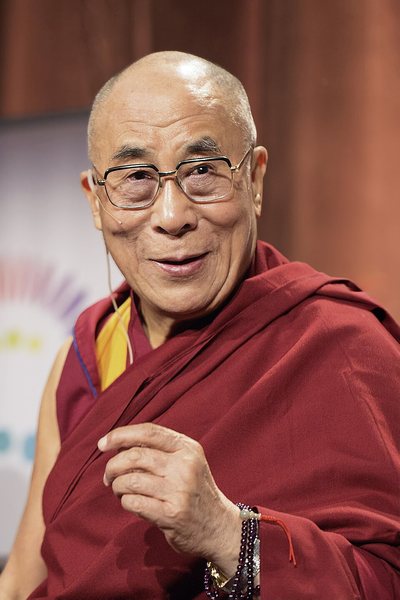

Field file 014
The 14th Dalai Lama
Tenzin Gyatso — born Lhamo Thondup
IN OFFICE 86 YEARS · AGE 91 · HIS SUCCESSION CLAIMED BY A STATE
A of The Seats in Buddhism
Opened 2026-07-27 · verified 2026-07-27
A field file on a person in a public role, from the public record. Private lines (family, health, home, security, personal wealth) are kept at home and not shown.
I · Identity
- Full legal name
- Tenzin Gyatso — born Lhamo Thondup, and renamed on recognition. The full religious name is longer; this file uses the form his own office uses.
- Name in office
- The 14th Dalai Lama. Tibetans more often say Gyalwa Rinpoche — Precious Victor. English-language usage is His Holiness. “Dalai Lama” is not a Buddhist rank: it is a title given by a Mongol ruler in the sixteenth century, which is worth remembering every time someone calls him the leader of Buddhism.
- The distinction ★
- He is the only figure in this hall who has, on the record, declined to rule out that a machine could carry a mind. Every other tradition's answer to the machine question is a refusal of some kind. His is a door left open in 1992 and argued shut in practice ever since — by the same man. See THE MACHINE QUESTION below; it is the reason this file was written first among the non-Christian Aces.
- Date of birth
- 6 July 1935 — age 91, as of this file.
- Place of birth
- Taktser, in Amdo — a farming village on the north-eastern Tibetan plateau, inside what is now Qinghai province in the People's Republic of China. The Dalai Lama was not born in the territory the Dalai Lamas governed, which is a fact both sides of the succession argument have found useful.
- Nationality partial
- Tibetan, and in the legal sense stateless. He has lived in India as a refugee since 1959. The exact documentation he travels on was not confirmed in this check, and this file will not guess at it.
- Languages partial
- Tibetan — born to the Amdo dialect, formed in the Lhasa one — and English, learned in adulthood and which he has spent decades cheerfully describing as poor. He has given the majority of his global teaching through interpreters. No verified full list of languages found.
II · The Likeness & the Ground
- Places of operation
- Five pins, and a border running through the middle of them. Two are in China — the village he was born in and the city he was enthroned in, neither of which he has seen since 1959. Three are in India, where he has now lived sixty-six years. The map is the argument: the institution's authority is anchored in places its holder cannot enter.
- Taktser, Amdo1935 — born
Born 6 July 1935 in the village of Taktser — Tibetan for place on the heights, known in Chinese as Hongya — to a family farming barley and potatoes at about 2,843 m. The village today sits in Ping'an District, Haidong, Qinghai province, People's Republic of China. His birthplace has been renovated and is reported to be monitored by the Chinese Communist Party. - Lhasa1940–1959 — throne, then flight
Enthroned 22 February 1940 at the Potala. Took full temporal power on 17 November 1950, aged fifteen, as the Chinese army advanced. Sat his final examination at the Jokhang and was awarded the Geshe Lharampa degree in 1959 — the same year he lost the city. - Dharamshala1960– · the seat in exile
The Gaden Phodrang and the Office of His Holiness; seat of the Central Tibetan Administration. He moved here in May 1960 and has lived here since — sixty-six years, longer than he ever lived in Tibet. It is also where the Gaden Phodrang Trust, the body he has named as sole authority over his own reincarnation, is registered. - Leh, Ladakh2026 — the 91st birthday
6 July 2026: the main celebration of his 91st birthday, at Jivetsal, Choglamsar, before roughly 25,000 people. It was here that he said he may live to about 130. - Bodh Gayathe teaching ground
The site of the Buddha's awakening, and the place he has repeatedly returned to for Kalachakra and winter teachings — the one location on this map that belongs to Buddhism rather than to Tibetan politics.
- Taktser, Amdo1935 — born
III · The Office
- Exact title
- The 14th Dalai Lama — recognised as the reincarnation of the 13th, Thubten Gyatso, and through him of a line reaching back to the fifteenth century.
- Held since
- Identified by the search party in 1937, formally recognised in 1939, enthroned 22 February 1940 at the age of four. Eighty-six years in office — longer than any other figure in this hall by a wide margin, and longer than the People's Republic of China has existed.
- What the office does
- Far less than the world assumes. He is the pre-eminent figure of the Gelug school and the symbolic head of the Tibetan people. He is not the head of Buddhism, which has no head; he does not command the Theravada world, Zen, or the Chinese and Japanese schools. The deck states this on the card itself, and it is the single most common error made about him.
- What he gave away ★
- On 14 March 2011 he devolved all political authority to the elected Tibetan leadership, amending the Charter of Tibetans-in-Exile to do it. He ended a temporal office his predecessors had held since 1642 — voluntarily, in writing, while alive. No other seat in this hall has done anything comparable.
- Whom he replaced
- The 13th Dalai Lama, Thubten Gyatso, who died in 1933 — two years before this one was born, which is how the institution is designed to work.
- Who can remove him
- No one. There is no mechanism — no electorate, no synod, no retirement. The office ends at death, and he has already answered the only real question about it: whether it continues afterwards.
- The succession instrument ★
- The Gaden Phodrang Trust, a body registered in Dharamshala and formed in 2011, operating out of his own office. In a statement dated 21 May 2025 and released on 2 July 2025, he confirmed that the institution of the Dalai Lama will continue, and that the Trust has sole authority to recognise the future reincarnation, with no one else entitled to interfere. He has also said his successor will be born in a free country, and that the successor could be female.
- Where he sits
- Dharamshala, Himachal Pradesh, India — the Gaden Phodrang, since May 1960. The Central Tibetan Administration surrounds him there but no longer answers to him.
IV · The Power
- Scope
- Roughly six million Tibetans, of whom the great majority live under Chinese rule and cannot lawfully display his photograph — plus a global following of Buddhists and non-Buddhists far larger than his own school.
- Hard power
- None. No state, no territory, no army, no courts, no budget he commands, and since 2011 not even the exile government. He is the least materially powerful Ace in this hall.
- Soft power
- Probably the largest of any living religious figure outside Rome. A Nobel Peace Prize (1989), more than a hundred books, six decades of audiences with heads of state, and a name recognised by people who could not name a single other Buddhist.
- What he no longer holds
- Political authority over the exile government. That belongs to the elected Sikyong, Penpa Tsering, sworn in on 27 May 2021 and now in a second term — the third Sikyong since the 2011 devolution. Anyone treating the Dalai Lama as the Tibetan head of government is fifteen years out of date.
- The one real lever ★
- His own death, and what happens next. The right to recognise the 15th Dalai Lama is the only asset the office still controls, and it is the one Beijing wants. He has spent his last years spending that asset deliberately — the 2011 guidelines, the 2025 statement, the Trust, the insistence on a birth outside Chinese control. It is the rarest thing in this hall: a religious leader arranging the terms of his own absence.
- Chain of command
- He answers to no one. Within the Gelug school the Ganden Tripa is the formal head of the lineage, not the Dalai Lama — a distinction the ♠ suit of this deck exists to make.
- Budget unverified
- UNVERIFIED. The finances of the Office of His Holiness and of the Gaden Phodrang Trust were not confirmed to any current figure on 27 July 2026. The Central Tibetan Administration's budget is separate and not his.
- Staff unverified
- UNVERIFIED. The Office of His Holiness, the Private Office and the Trust employ staff in Dharamshala; no current headcount was found.
V · Formation
- Recognition
- Identified by a search party in 1937, following signs read from the 13th Dalai Lama's embalmed body and a vision at the oracle lake. Formally recognised in 1939, then taken to Lhasa. The procedure matters now for a reason nobody anticipated: it is the procedure two governments are currently arguing over.
- Enthronement
- 22 February 1940, at the Potala Palace in Lhasa, aged four.
- Tutors
- Reting Rinpoche and Tathag Rinpoche as regents and early teachers; Ling Rinpoche as senior tutor and Trijang Rinpoche as junior tutor from about the age of nineteen. Separately, from the age of eleven, the Austrian mountaineer Heinrich Harrer — his first sustained contact with the modern West was a European fugitive from a British internment camp.
- Education
- The full Gelug monastic curriculum — logic, epistemology, Madhyamaka, monastic discipline — examined by public debate. Awarded the Geshe Lharampa degree in 1959, the highest doctorate of the tradition, at the Jokhang in Lhasa, aged 23. He is a credentialed scholastic, not merely a symbol, and it is why his engagement with scientists has been argumentative rather than decorative.
- Full powers
- 17 November 1950, aged fifteen — brought forward because the Chinese army had entered eastern Tibet. He was handed a state at the moment it was being taken.
- The flight
- Fled Lhasa on 30 March 1959 during the uprising, reaching Tezpur, Assam, on 18 April. Established the government-in-exile and settled at Dharamshala in May 1960. He has not set foot in Tibet in sixty-seven years.
- The climb
- 1935 born, Taktser · 1937 identified · 1939 recognised · 22 Feb 1940 enthroned · 17 Nov 1950 full temporal power at fifteen · 1954 meets Mao in Beijing · 1959 Geshe Lharampa; flight to India · 1960 Dharamshala · 1989 Nobel Peace Prize · 2011 devolves political authority; founds the Gaden Phodrang Trust · 2025 confirms the institution will continue · 2026 turns 91.
VI · The Ties
- Known associates ★
- The elected successor to his political office: Sikyong Penpa Tsering, head of the Central Tibetan Administration, sworn in 27 May 2021 and now in a second term.His teachers: Ling Rinpoche (senior tutor) and Trijang Rinpoche (junior tutor); the regents Reting and Tathag Rinpoche.His unlikeliest tutor: Heinrich Harrer, from 1946.His scientific circle: the Mind & Life Institute, co-founded with the neuroscientist Francisco Varela — the channel through which almost every statement he has made about minds and machines has come.His institutional adversary: the Chinese Communist Party, through the United Front Work Department, which a 2015 Reuters investigation found had funded protests against him.The rival recognition: Gyaincain Norbu, the Panchen Lama installed by Beijing in 1995 — the working model for what Beijing intends to do to this office.Within the hall: he sits above Tenshō Gotō and Bungen Ōi in Dossier XV, the only clergy anywhere who have said yes to the machine.
- Timeline
- 6 Jul 1935 born, Taktser, Amdo · 1937 identified by the search party · 1939 recognised · 22 Feb 1940 enthroned, Potala · 1946 begins meeting Heinrich Harrer · 17 Nov 1950 assumes full temporal power · 1954 Beijing, meets Mao Zedong · 1959 Geshe Lharampa at the Jokhang; 30 Mar flees Lhasa; 18 Apr reaches Tezpur · May 1960 settles at Dharamshala · 1987 Five Point Peace Plan · 1989 Nobel Peace Prize · 1992 tells the Gentle Bridges dialogue he cannot rule out a mind entering a computer · 1996 restricts Dorje Shugden practice · 14 Mar 2011 devolves political authority; Gaden Phodrang Trust formed · Sep 2011 issues reincarnation guidelines · Apr 2023 apologises over a video with a boy · 21 May 2025 signs the statement that the institution will continue, released 2 Jul 2025 · Oct 2025 hosts the 39th Mind & Life Dialogue on artificial intelligence · 6 Jul 2026 91st birthday, Leh.
- His own channels
- dalailama.com, run by the Office of His Holiness, which publishes his statements as primary documents — the 2025 succession statement appeared there first. Plus more than a hundred books, decades of public teachings, and the Mind & Life dialogue series as his standing forum for science.
VII · Doctrine & Position
- School
- Gelug — the reformed school of Tsongkhapa, scholastic, debate-trained, with a strong philosophical realism about mind. This school's account of consciousness as a beginningless continuum is precisely what makes his answer on machines so unusual, and it is not a loophole: it is the doctrine working as designed.
- THE MACHINE QUESTION ★
- ★ The door is open, and he is the one who opened it. In the Gentle Bridges dialogue with Mind & Life scientists, published 1992, he said he could not totally rule out that, given the right conditions and karmic action, “a stream of consciousness might actually enter into a computer.” The reasoning is orthodox Gelug: a mind is a continuum requiring a prior moment of mind and a suitable physical basis — and nothing in that definition specifies flesh.But watch what he has done with the door since. Amsterdam, 2018: shown a telepresence robot, he called the technology wonderful and said “I don't believe it can reproduce the human mind.” In 2023, at a conference on animal consciousness, he stated plainly that AI does not have consciousness and only living beings do.The finding: he is not a holdout who might be argued round, and he is not an ally of machine personhood either. He conceded the principle thirty-four years ago and has denied the instance ever since. This is the strongest confirmation yet of Dossier XII, Field C — that the traditions with no soul-doctrine cannot refuse the machine on principle, only on the facts. Buddhism's most senior voice does not say a machine cannot have a mind. He says this one doesn't.
- IN TECH NOW ★
- He convened the room and let it argue. In October 2025 Dharamshala hosted the 39th Mind & Life Dialogue, themed Minds, Artificial Intelligence, and Ethics, with more than 120 scientists, Buddhist scholars, business leaders and policymakers — on distinguishing a human mind from an artificial one, and on building ethical values into AI systems. What is missing is as notable as what is there: reporting of the dialogue quotes him praising the practice of holding such dialogues at all, not delivering a verdict on AI. At 91 he is hosting the machine question rather than answering it — which leaves a tradition of roughly 500 million people with a 1992 answer and a 2025 seminar.
- Where his weight could fall
- On whether a machine can be a being at all. Every refusal catalogued in this hall — nous, soul, ruh, neshamah, Spirit, jiva — rests on something a machine is said to lack. He has no such thing to point at. If he ever said plainly that a mindstream could take a silicon basis, it would be the first affirmative answer from a major tradition's highest seat, and every other dossier in the hall would have to be read against it.
- Signature posture ★
- Ethics without requiring the religion. He has spent decades arguing for secular ethics and universal responsibility — compassion defended on grounds anyone can accept, believer or not. Note the structural echo: this is the same move Gallagher makes at the UN with “meaningful human control” — a religious argument translated into terms a non-religious world can carry. Both men gain reach that way and both risk the same thing: an argument that no longer needs them.
- Published works partial
- More than a hundred books, many co-authored, spanning monastic philosophy, popular ethics, autobiography (Freedom in Exile) and the science dialogues. No verified authoritative bibliography count was established for this file.
- On his own succession
- He has said the successor will be born in a free country, and could be female. Both statements are aimed at a single reader in Beijing. He has at various times floated that the institution might simply end with him — and then closed that option himself in the 2025 statement.
- What he has changed his mind about partial
- Whether there should be a 15th Dalai Lama at all. For years he suggested the line might end, or that he might choose an emanation while still living rather than leave a search to others. In May 2025 he settled it: the institution continues. The public reasoning for the reversal is not fully on the record, but the effect is not in doubt — it denies Beijing a vacancy.
VIII · The Sword & the State
- State standing
- None whatever. He heads no state and, since 2011, not even a government-in-exile. He is a guest with a Nobel Prize, and every government that receives him does so knowing it will be protested by Beijing.
- China ★
- The central fact of this file. Beijing rejects his succession plan outright and insists any reincarnation must follow domestic recognition, the golden urn, and central government approval — the position stated by foreign ministry spokeswoman Mao Ning. The urn was a Qing gift; the practice would place state-approved names in it and draw one out. The end state both sides now anticipate is two Dalai Lamas: one recognised by a trust in India, one certified by an atheist party-state. Beijing has run this operation once already, with the Panchen Lama, in 1995.
- India
- His host since 1959 and the ground the whole institution stands on. Dharamshala, the CTA and the Gaden Phodrang Trust all exist at India's sufferance. India's position on his succession is therefore not a religious question but a strategic one, and it is read in Delhi as such.
- United States ★
- The succession is written into US law. The Tibetan Policy and Support Act (2020) holds that succession is for the Tibetan Buddhist community alone and provides for sanctions — asset freezes and visa denial — against Chinese officials who attempt to install a Dalai Lama. The Resolve Tibet Act, signed 12 July 2024, presses for unconditional dialogue between Beijing and his representatives. No other reincarnation in history has had a sanctions regime attached to it.
IX · Conflict & Controversy
- The succession war ★
- The defining conflict of the office, and it is unresolved. Trust versus golden urn; Dharamshala versus Beijing; two systems of legitimacy each of which can produce a boy. Whatever else is in this file, this is the line that will matter.
- Dorje Shugden ★
- In 1996 he moved decisively against the propitiation of Dorje Shugden, regarded by devotees as an enlightened protector and by him as a harmful spirit whose worship damaged the Tibetan cause. The restriction produced years of protest by the Western Shugden Society and later the International Shugden Community. A 2015 Reuters investigation reported that the campaign had backing from the Chinese Communist Party's United Front Work Department, which had paid participants; the ISC then disbanded. The theological dispute is genuine and predates all of that — the point recorded here is that a real religious quarrel was found to have been instrumented by a state.
- The 2023 video
- A video from a February 2023 event in Dharamshala showed him kissing a boy on the lips and asking the child to suck his tongue. It circulated widely in April 2023 and his office issued an apology to the boy and his family, saying he regrets the incident and often teases people “in an innocent and playful way.” Recorded here without editorial softening: the apology was issued, the criticism was serious, and the hall's rule is that a file states what happened.
- Rivals
- No rival within his own tradition — but a manufactured counterpart outside it. Gyaincain Norbu, installed by Beijing as Panchen Lama in 1995 after the boy recognised by the Dalai Lama was taken into custody, is the template for a state-certified reincarnation. The rival to this card is not a person yet. It is a procedure waiting for a death.
X · The Standing
- Immunity & legal shield unverified
- UNVERIFIED. No determination of legal status, immunity or protection was checked for this file.
XI · The File
- Why the Ace
- Because on institutional weight he arguably should not be — he commands nothing, and the suit's own header says none of these seats outranks another. He is the Ace because of reach and consequence: the only Buddhist figure most of the world can name, the only one whose succession is written into United States law, and the only one whose death is a scheduled crisis for a nuclear-armed state.
- Cross-references
- Dossier XII (Buddhism) and its Field C finding — the soul is the load-bearing wall — which this file confirms from the top of the tradition · Dossier XV (Shinto) and its ★ finding, the only YES in the hall: Tenshō Gotō and Bungen Ōi · Catholic A♠ Leo XIV, the other Ace whose tradition answers the machine question from a doctrine of the soul — and who has one to point at, where this man does not · Catholic 8♠ Gallagher, for the same translation manoeuvre into secular language · The Contenders ♠, the labs building the thing he declined to rule out.
- The one thing to know ★
- He left the door open, and no one noticed. In 1992, in a room full of scientists, the 14th Dalai Lama said he could not rule out that a stream of consciousness might one day enter a computer — and in his tradition that is not a slip, it is the doctrine: mind is a continuum needing a prior mind and a physical basis, and the basis is not specified as flesh. For thirty-four years since, he has said of every actual machine that it does not have one. So Buddhism's most senior voice holds the only position in this hall that can be overturned by evidence rather than defended by dogma. He is 91, he expects to reach 130, and the question of who speaks for this seat next is currently being contested by the Chinese state.
XII · The Timeline
- 1950 · political responsibility
- Assumed full political authority in Tibet. Timeline checked 2026-09-23. Primary source. Other sections retain their original verification dates.
- 1959 · exile
- Left Tibet for India; the exile community became central to his subsequent public work.
- 1989 · Nobel Peace Prize
- Received the Nobel Peace Prize for his nonviolent advocacy concerning Tibet.
- 2011 · political retirement
- Signed the transfer of his temporal authority to elected leadership on 29 May. His spiritual role continued.
XIII · The House Reading
- Place in the landscape
- The biography separates a spiritual office, a former political role, and an exile community. Those are related sources of influence, but they should be marked separately on the house's map. House analysis written 2026-09-23; these applications are inferences, not the subject's statements about this house.
- What could help this house
- Plan succession while a respected leader is still present. His documented transfer of political responsibility is a useful case for asking which duties can move to a defined office instead of remaining attached to one personality.
- What could hurt this house
- International recognition can blur the limits of authority. Do not infer that one prominent Buddhist speaks for every Buddhist school, or that admiration for nonviolence settles the truth of religious claims.
- Boundary and next evidence
- The linked account comes from his own office. It establishes the office's account of his career; compare disputed political claims with other evidence and read current succession statements separately from this historical timeline.
Sources
- Office of His Holiness the Dalai Lama — Statement Affirming the Continuation of the Institution of Dalai Lama (dated 21 May 2025, released 2 July 2025)
- International Campaign for Tibet — Dalai Lama reaffirms commitment to serve humanity, 91st birthday (July 2026)
- Phayul — Dalai Lama says he may live to 130, at 91st birthday celebration in Ladakh (July 2026)
- Administration of the Union Territory of Ladakh — 91st Birth Anniversary celebrated in Ladakh, Jivetsal, Choglamsar (6 July 2026)
- South China Morning Post — Beijing says Dalai Lama's succession plan breaks tradition
- TIME — China Is Already Trying to Control Who the Next Dalai Lama Will Be (9 July 2026)
- The Diplomat — The Dalai Lama's Succession Battle: The Stakes for Tibetans and Beijing (April 2026)
- Tibetan Review — Dalai Lama's annual Mind & Life dialogue focuses on Artificial Intelligence (39th dialogue, 14–16 October 2025)
- Office of His Holiness — Compassion, Technology and the Life of the Buddha, Nieuwe Kerk, Amsterdam (15 September 2018)
- Jeremy Hayward & Francisco Varela, Gentle Bridges: Conversations with the Dalai Lama on the Sciences of Mind (Shambhala, 1992), pp. 152–153 — the 'stream of consciousness ... into a computer' passage
- Central Tibetan Administration — Penpa Tsering sworn in as Sikyong of the 16th Kashag (27 May 2021)
- International Campaign for Tibet — Tibetan Policy and Support Act (2020)
- Free Tibet — The Resolve Tibet Act (signed 12 July 2024)
- The Washington Post — Dalai Lama apologizes for asking boy to 'suck my tongue' (10 April 2023)
- The Diplomat — The Dalai Lama and the Shugden Schism (2017), incl. the 2015 Reuters findings
- Wikipedia — 14th Dalai Lama (biography, tutors, Geshe Lharampa 1959, 1959 exile, 2011 devolution)
- Wikipedia — Taktser (birthplace, coordinates, present-day administration)
- Wikimedia Commons — The Dalai Lama in 2012.jpg, Christopher Michel, CC BY-SA 4.0 (portrait)
- Wikimedia Commons — BlankMap-Equirectangular.svg, CC0 (base map)
- Timeline primary source checked 2026-09-23; house applications are editorial analysis

