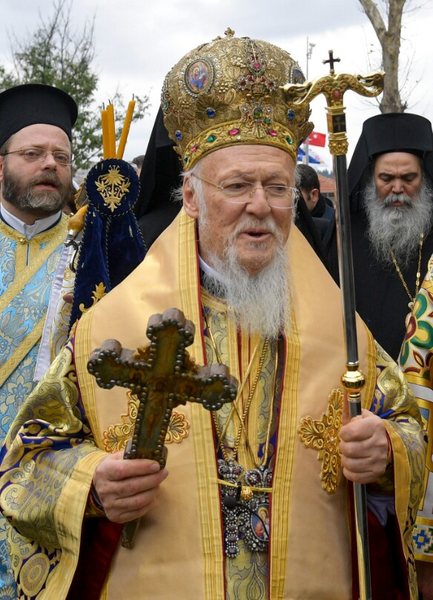

Field file 015
Bartholomew I
Dimitrios Archontondis (Archontonis)
REIGNING 35 YEARS · AGE 86 · A SUCCESSION HIS HOST STATE CAN VETO
A of The Thrones in The Eastern Orthodox Church
Opened 2026-07-27 · verified 2026-07-27
A field file on a person in a public role, from the public record. Private lines (family, health, home, security, personal wealth) are kept at home and not shown.
I · Identity
- Full legal name
- Dimitrios Archontonis — the Turkish civil record renders the surname Arhondonis. He is, in law, a Turkish citizen named Dimitrios, and that is not a footnote: it is the legal fact on which the whole see now depends.
- Name in office ★
- Bartholomew I, Archbishop of Constantinople, New Rome, and Ecumenical Patriarch. Styled His All-Holiness. Described as the 270th successor of the Apostle Andrew. Turkey does not recognise the word “ecumenical” in that title; he has said it is the one thing he insists on and will never renounce.
- The distinction ★
- Two Aces, two states holding the succession. Read this card immediately after the 14th Dalai Lama (Buddhism A♠). Beijing intends to certify the next Dalai Lama; Ankara has held a veto over the next Ecumenical Patriarch for decades, and closed the only seminary that produced eligible candidates in 1971. One state is preparing its lever. The other has had its hand on it for fifty-five years.
- Date of birth
- 29 February 1940 — age 86. A leap-year birth, so the date itself exists roughly once in four years.
- Place of birth
- Zeytinliköy (Agios Theodoros), on the island of Imbros — Gökçeada — Turkey. An island whose Greek community has been steadily reduced across his lifetime.
- Nationality
- Turkish. Required by Turkish law for the office. He served in the Turkish armed forces as a reserve officer, 1961–1963 — the senior bishop of Eastern Orthodoxy did national service in a Muslim-majority republic.
- Languages
- Seven, at working level: Greek, Turkish, Latin, Italian, French, English and German. Among the most linguistically equipped figures in the hall, which is the practical basis of his ecumenical reach.
II · The Likeness & the Ground
- Places of operation
- A see the size of a neighbourhood, and a jurisdiction the size of a continent. Four of the five pins sit within a few hundred miles: the island he was born on, the seminary that trained him and was then shut, the Phanar, and Rome where he took his doctorate. The fifth is Kyiv, and it is the one that changed world Orthodoxy.
- Imbros (Gökçeada)1940 — born
Born 29 February 1940 in the village of Zeytinliköy (Agios Theodoros) on the island of Imbros, then as now inside Turkey. He is a Turkish citizen by birth, and everything in Section VIII follows from that. - Halki (Heybeliada)1958–1961 · closed 1971
The Theological School of Halki, where he took a bachelor's degree with highest honours, thesis on the restoration of dissolved marriage. Turkey closed it in 1971 under a law nationalising private higher education. The school that formed him has been shut for the whole of his patriarchate. - The Phanar1991– · the throne
St George's Cathedral at the Phanar (Fener), Istanbul — the seat of the Ecumenical Patriarchate. Elected 22 October 1991, installed 2 November 1991. A see with roughly 300 million faithful worldwide and a local flock in the low thousands. - Rome1963–1968 — the doctorate
Pontifical Oriental Institute: doctorate in canon law, on the codification of the sacred canons. The senior figure of Eastern Orthodoxy took his doctorate in a Roman Catholic institution — which is a large part of why his patriarchate has been the ecumenical one. - Kyiv2019 — the tomos
In January 2019 he granted autocephaly to the Orthodox Church of Ukraine. Moscow severed communion. The largest rupture in Orthodoxy in centuries, and the act by which this reign will be remembered.
- Imbros (Gökçeada)1940 — born
III · The Office
- Exact title
- Archbishop of Constantinople, New Rome, and Ecumenical Patriarch. The first throne of the Orthodox communion.
- Held since
- Elected 22 October 1991, installed 2 November 1991 — thirty-five years, the longest reign of any Ecumenical Patriarch in the modern era.
- What the office does
- First among equals — and the argument is about what “first” means. He has no jurisdiction over the other autocephalous churches, but holds the prerogatives of convening councils, hearing appeals, and granting autocephaly. Moscow's position is that these are honorary. His position is that they are real, and in 2019 he used one.
- The size of the see ★
- The gap that defines the office. He is described as leading an Orthodox world of some 300 million, while the Greek Orthodox population of Istanbul itself has fallen to a few thousand. Enormous canonical standing resting on a local community that can no longer reliably supply him with a successor.
- Whom he replaced
- Patriarch Demetrios I, who died in 1991.
- How he is chosen ★
- By the Holy Synod of the Ecumenical Patriarchate — but from a field the Turkish state defines. Candidates must be Turkish citizens, and Turkish decrees have provided the government a means to veto an election. The most senior seat in Orthodoxy is filled subject to the approval of a secular republic.
- Who can remove him
- No church body in practice. He reigns for life. The real constraint is not ecclesiastical but civil — his standing in Turkey and the legal status of the Patriarchate.
- Halki partial
- The Theological School of Halki, closed by Turkey in 1971 and the single longest-running demand of his patriarchate. He has told interlocutors that a dialogue begun at President Erdoğan's initiative aims to welcome the first students in September 2026. As of this file it has not reopened. Reported plans describe reopening it as a university. Treat any reopening as unconfirmed until students are actually admitted.
IV · The Power
- Scope
- Direct jurisdiction over a small flock; canonical primacy over roughly 300 million Orthodox Christians worldwide, including the Greek diaspora churches of America, Europe and Australia, and the monastic republic of Mount Athos.
- Hard power
- Real but narrow. He can convene a council, receive appeals, and grant or withhold autocephaly — the power to call a national church into canonical existence. He exercised it once, in 2019, and the Orthodox world has not recovered.
- Soft power
- Very large. The Congressional Gold Medal (1997), the Sophie Prize (2002), the Templeton Prize (2025), election as a foreign associate of the Academy of Moral and Political Sciences (2025) in a seat previously held by Benedict XVI, and thirty-five years of access to presidents and popes.
- The Green Patriarch
- The brand that made him globally legible. Decades of environmental theology — framing ecological damage as sin — earned him the nickname and, in 2025, the Templeton Prize. Note the method, because it recurs below: he takes a doctrinal claim and states it in terms the secular world already accepts.
- The Moscow rupture ★
- Since 2019 the Moscow Patriarchate has been out of communion with him, following the Ukrainian autocephaly. In April 2026 Patriarch Kirill again attacked the special responsibilities the Ecumenical Patriarchate claims. The largest Orthodox church on earth by population does not currently recognise the first throne's exercise of its prerogatives.
- Chain of command
- He answers to no superior. He governs with the Holy Synod of the Patriarchate.
- Budget unverified
- UNVERIFIED. The Patriarchate's finances rest substantially on diaspora support, particularly from the Greek Orthodox Archdiocese of America. No current figure confirmed on 27 July 2026.
- Staff unverified
- UNVERIFIED. The Phanar operates with a small permanent staff and the Holy Synod; no current headcount found.
V · Formation
- Education
- Halki Theological School, 1958–1961, graduating with highest honours. Then postgraduate work at the Pontifical Oriental Institute in Rome, the Ecumenical Institute at Bossey in Switzerland, and the University of Munich. Three countries and two confessions before he was thirty.
- Doctorate
- Doctorate in canon law, Pontifical Oriental Institute, Rome, 1963–1968, on the codification of the sacred canons and ecclesiastical decrees. He is a canonist by training — which is exactly the discipline the Ukraine decision turned on.
- Ordination
- Deacon 13 August 1961 · priest 19 October 1969 · consecrated bishop 25 December 1973.
- Military service
- Reserve officer in the Turkish armed forces, 1961–1963.
- The Phanar years partial
- Rose through the Patriarchate's own administration after his consecration in 1973, serving as Metropolitan and as a member of the Holy Synod before his election. The detailed sequence of sees was not fully re-verified for this file.
- The formation that shaped the reign ★
- Halki, then Rome. An Orthodox seminary that Turkey would shortly close, followed by a Roman Catholic doctorate. The two facts explain the two halves of his patriarchate — a lifelong campaign against a Turkish closure, and a lifelong openness to Rome.
- The climb
- 1940 born, Imbros · 1958–61 Halki · 1961 deacon; enters Turkish military service · 1963–68 doctorate, Rome · 1969 priest · 1973 bishop · 1991 elected and installed Ecumenical Patriarch · 1997 Congressional Gold Medal · 2016 the Holy and Great Council in Crete · 2019 Ukrainian autocephaly; Moscow breaks communion · 2025 Templeton Prize · 2026 presses for Halki's reopening in September.
VI · The Ties
- Known associates ★
- His adversary: Patriarch Kirill of Moscow — out of communion since 2019, and attacking the Phanar's prerogatives again in April 2026.His Ukrainian counterpart: the Orthodox Church of Ukraine, which exists canonically because he said so in January 2019.Rome: a working relationship with the papacy going back to his Roman doctorate; the Ecumenical Patriarch is the standing Orthodox interlocutor of the Catholic A♠, Leo XIV.His host: the Republic of Turkey and President Erdoğan, with whom the Halki dialogue runs.His financial and diaspora base: the Greek Orthodox Archdiocese of America and the Archons.Mount Athos: under his jurisdiction; he received the abbot of Esphigmenou with Ukrainian clergy on 23 July 2026.
- Timeline
- 29 Feb 1940 born, Zeytinliköy, Imbros · 1958–1961 Halki, first-class degree · 13 Aug 1961 ordained deacon · 1961–1963 Turkish army reserve officer · 1963–1968 doctorate in canon law, Pontifical Oriental Institute, Rome; also Bossey and Munich · 19 Oct 1969 ordained priest · 1971 Turkey closes Halki · 25 Dec 1973 consecrated bishop · 22 Oct 1991 elected Ecumenical Patriarch, installed 2 Nov · 1997 Congressional Gold Medal · 2002 Sophie Prize · 2016 Holy and Great Council, Crete · Jan 2019 tomos of autocephaly to Ukraine; Moscow severs communion · Dec 2024 Athens, on spiritual intelligence · 2025 Templeton Prize; elected to the Academy of Moral and Political Sciences · 8 May 2026 “Life is not digital” · Sep 2026 the date he has given for Halki's first students.
- His own channels
- The Patriarchate's own publications and the Orthodox Times and Orthodox Observer outlets, plus the Archons of the Ecumenical Patriarchate in the United States, who carry his religious-freedom case in Washington. He is unusually well covered in English for an Eastern primate, and that is deliberate.
VII · Doctrine & Position
- School
- Byzantine Orthodox, canonically trained, ecumenically inclined. A canonist rather than a systematic theologian — his major acts have been jurisdictional, not doctrinal.
- THE MACHINE QUESTION ★
- ★ Answered, recently, and squarely on the soul. On 8 May 2026, addressing students, he said “Life is not digital” — that the human soul is filled with emotions, empathy and spontaneous hierarchies, and that real life is more than measurable reality, more than numbers. To the Hellenic Broadcasting Corporation the same day he said AI cannot fulfil the deepest longings of the human soul. Earlier, in December 2024 in Athens, he urged the young to cultivate “spiritual intelligence” against the artificial kind. He has also said it is certain we will speak of the period before and after AI — he regards it as an epoch, not a tool.Read this card against the Dalai Lama's. Buddhism's Ace could not rule out a mind entering a computer, because his doctrine of mind does not specify flesh. Orthodoxy's Ace refuses in one sentence, because his does. This is Field C of Dossier XII demonstrated twice in two days of building: the soul is the load-bearing wall, and where there is no soul-doctrine there is no wall.
- IN TECH NOW ★
- Speaking, repeatedly, to the young — and doing nothing institutional that this check could find. Four dated interventions in eighteen months (Athens December 2024; September 2025 on the limits of science; April 2026 on suffering behind the statistics; 8 May 2026 on AI and the soul). What is absent: no Patriarchate office for technology, no synodal document on AI, no policy for the Phanar's own use of it. Compare Rome, which answers the machine through a five-office relay ending at the UN Security Council. Constantinople answers it in speeches to students.
- Where his weight could fall
- On the ecological frame, transferred. He spent thirty years teaching the world to hear environmental damage as a moral and spiritual category rather than a technical one. That is precisely the move the AI argument now needs, and he is the only figure in the hall who has already done it once and been given a Templeton Prize for it.
- Signature posture ★
- Say the doctrine in words the secular world already accepts. Creation care instead of dominion; “spiritual intelligence” against artificial intelligence. The same manoeuvre as Gallagher's “meaningful human control” — and it carries the same risk the hall has already recorded: an argument phrased for everyone can end up belonging to no church.
- Published works partial
- Encyclicals, addresses and the book Encountering the Mystery (2008), plus a large body of ecological and ecumenical addresses. No verified full bibliography compiled for this file.
- On Rome
- The most Rome-friendly Ecumenical Patriarch in centuries — a Roman doctorate, sustained joint declarations, and a working relationship with successive popes. Moscow's case against him is partly that this closeness is itself the problem.
- What he has changed his mind about unverified
- UNVERIFIED. No documented reversal was established in this check. The Ukrainian decision was long-resisted before it was granted, but this file will not characterise that as a change of mind without a source.
VIII · The Sword & the State
- State standing
- None, and less than none. Turkey recognises him as the head of a local Greek Orthodox community, not as an ecumenical patriarch. The Patriarchate has no legal personality of the kind a church of this standing would normally hold.
- Turkey ★
- The determining relationship of the whole file. Turkish law requires the Patriarch to be a Turkish citizen and has given the government means to veto the election; Halki has been closed since 1971; the Greek community of Istanbul has shrunk to a few thousand. The state does not need to attack the office. It only has to wait, and control who is eligible.
- The United States
- His most reliable external patron. The Congressional Gold Medal (1997), sustained Congressional pressure on Turkey to reopen Halki, and the Archons lobbying in Washington. He has raised Halki directly with a US president.
- Russia
- An adversary with a state behind it. The Moscow Patriarchate's rupture is not merely canonical; it runs alongside Russian state interests, and Orthodox outlets describe a sustained information campaign against the Phanar. Ukraine is where church and war are the same map.
IX · Conflict & Controversy
- The Moscow schism ★
- The defining conflict. The January 2019 grant of autocephaly to Ukraine led Moscow to break communion. The dispute is about whether the first throne's prerogatives are honorary or real — that is, about whether his office is what it says it is. It remains unresolved, and was restated hostilely by Kirill in April 2026.
- The title
- Turkey's refusal of the word “ecumenical” is a standing dispute of his entire reign. He has said flatly that he will never renounce it.
- Halki ★
- Fifty-five years of a closed seminary. Repeated promises of reopening have not been kept; the current promise names September 2026. The controversy is not theological — it is that a state has been permitted to strangle a church's clergy pipeline in plain sight for over half a century.
- Rivals
- Patriarch Kirill of Moscow, whose church claims the largest Orthodox population and disputes the Phanar's authority. Within his own synod no rival is publicly identified — the constraint on his succession is legal, not factional.
X · The Standing
- Immunity & legal shield unverified
- UNVERIFIED. He holds no diplomatic status; the Patriarchate is not a sovereign entity. No specific legal protections were confirmed.
XI · The File
- Why the Ace
- Because among the primates of the autocephalous churches he holds the only prerogative that can change the shape of Orthodoxy, and in 2019 he used it. Moscow has more people, more money and a state; Constantinople has the canon, and this man has spent thirty-five years insisting the canon is not a courtesy.
- Cross-references
- Dossier I (Eastern Orthodoxy) · Buddhism A♠, the 14th Dalai Lama — the other Ace whose succession a state intends to control, and the opposite answer to the machine question · Catholic A♠ Leo XIV, his standing ecumenical counterpart · Catholic 8♠ Gallagher, for the identical strategy of translating doctrine into secular terms · Dossier XII, Field C — this file is a direct confirmation of it.
- The one thing to know ★
- He is the most canonically powerful bishop in Orthodoxy and the most legally exposed man in this hall. Bartholomew I speaks for roughly 300 million people from a walled compound in Istanbul, over a local flock of a few thousand, under a state that will not say his title, that closed his seminary in 1971, and that can object to whoever comes next. In 2019 he used the one power the office really has and lost communion with the largest church in his own communion for it. In May 2026 he answered the machine question in four words — life is not digital — and the reason he could answer so fast, where the Dalai Lama could not, is that he has a soul to point at.
XII · The Timeline
- 1972 · patriarchal office
- Became director of Patriarch Dimitrios' personal office. Timeline checked 2026-09-23. Primary source. Other sections retain their original verification dates.
- 1973 · episcopate
- Consecrated bishop and named Metropolitan of Philadelphia on Christmas Day.
- 1990 · Chalcedon
- Enthroned as Metropolitan of Chalcedon on 14 January.
- 1991 · patriarchate
- Elected Ecumenical Patriarch on 22 October and enthroned on 2 November.
XIII · The House Reading
- Place in the landscape
- His career joins patriarchal administration, episcopal office, and international church relations. Prominence within Orthodoxy must be mapped alongside the distinct institutions with which he deals. House analysis written 2026-09-23; these applications are inferences, not the subject's statements about this house.
- What could help this house
- Keep conversation possible across disagreement while writing down what remains unresolved. Contact between leaders is evidence of contact; an actual agreement needs its own text and signatories.
- What could hurt this house
- Treating an honorific or a ceremonial first place as unlimited jurisdiction distorts the landscape. The house must identify who accepts a decision, who disputes it, and where it is actually implemented.
- Boundary and next evidence
- This archdiocesan biography establishes a career chronology. For jurisdictional disputes, read the formal decisions and responses of the institutions concerned; this timeline alone cannot settle them.
Sources
- Orthodox Observer — 'Life is not digital,' says Ecumenical Patriarch Bartholomew on AI (8 May 2026, with Athens December 2024 and September 2025 remarks)
- Ecumenical Patriarchate — Autocephaly of the Orthodox Church of Ukraine (documents)
- Wikipedia — 2018 Moscow–Constantinople schism
- Wikipedia — Bartholomew I of Constantinople (biography, education, ordinations, election, honours)
- Archons of the Ecumenical Patriarchate — Forcible Closure of Halki Theological Seminary (closed 1971)
- Archons of the Ecumenical Patriarchate — Ecumenical Patriarch speaks of his hopes for Halki, first students in September 2026
- Al-Monitor — Will Turkey's long-closed Halki Seminary finally reopen for class? (October 2025)
- Türkiye Today — Türkiye plans to reopen Halki seminary as university after more than 50 years
- Archons of the Ecumenical Patriarchate — What Is the Ecumenical Patriarchate? (270th successor of St Andrew; c. 300 million faithful)
- Orthodox Times — Ecumenical Patriarch receives Abbot of Esphigmenou and Ukrainian clergy (23 July 2026)
- Orthodox Times — Russia's information war against the Ecumenical Patriarchate
- The National Herald — He Is in Excellent Health (December 2025)
- The National Herald — Biography of Ecumenical Patriarch Bartholomew
- Wikimedia Commons — Bartholomew I of Constantinople.jpg, Presidential Administration of Ukraine, CC BY 4.0 (portrait)
- Wikimedia Commons — BlankMap-Equirectangular.svg, CC0 (base map)
- Timeline primary source checked 2026-09-23; house applications are editorial analysis

