
Field file 016
Ahmed el-Tayeb
Ahmed Mohamed Ahmed el-Tayeb (Ahmad al-Tayyib)
REIGNING 16 YEARS · AGE 80 · A THOUSAND-YEAR INSTITUTION WITH NO POPE AT ITS HEAD
A of The Scholars in Islam
Opened 2026-07-27 · verified 2026-07-27
A field file on a person in a public role, from the public record. Private lines (family, health, home, security, personal wealth) are kept at home and not shown.
I · Identity
- Full legal name
- Ahmed Mohamed Ahmed el-Tayeb, rendered in English variously as Ahmad al-Tayyib or Ahmed al-Tayeb. Transliteration varies across sources; this file uses the spelling on his own institution's English materials.
- Name in office ★
- Grand Imam of Al-Azhar — Sheikh al-Azhar in Arabic. Head of Al-Azhar Al-Sharif, founded in 970 CE: roughly 1,056 years old, and Sunni Islam's most credentialed seat of learning.
- The distinction ★
- There is no Sunni pope, and this card is the closest analogue there is. Unlike the Catholic A♠, el-Tayeb commands no global hierarchy — Sunni Islam has no ordination chain running through him, no diocese reporting to Cairo. His authority is the prestige of Al-Azhar's millennium of scholarship, not a chain of command. Read this card against every other Ace in the hall for exactly that contrast.
- Date of birth
- 6 January 1946 — age 80.
- Place of birth
- Al-Qarnah (Qurna), on the Nile's west bank opposite Luxor, then part of Qena Governorate, Upper Egypt.
- Nationality
- Egyptian.
- Languages partial
- Arabic (native), with working French from his Paris years. No further language proficiencies verified.
II · The Likeness & the Ground
- Places of operation
- Upper Egypt to Cairo to Paris and Islamabad, and then to Abu Dhabi. A formation entirely inside Al-Azhar's own system, a foreign postgraduate interlude, a decade teaching abroad — and then the single trip, in 2019, that put his signature next to a pope's.
- al-Qarnah, Luxor1946 — born
Born 6 January 1946 in al-Qarnah (Qurna), on the west bank of the Nile opposite Luxor, then part of Qena Governorate. Into a hereditary Sufi family — he is himself a shaykh of the Khalwati order, a lineage that runs through everything above and below this pin. - Cairo — Al-Azhar1969– · formation and the throne
Al-Azhar University: BA (1969), MA (1971) and PhD (1977) in Islamic philosophy. Later President of Al-Azhar University (2003–2010), and Grand Imam since 10 March 2010. Founded in 970 CE — roughly 1,056 years old — Al-Azhar is the closest thing Sunni Islam has to a doctrinal center of gravity, though it commands no hierarchy the way Rome does. - Paris — the Sorbonne1977–1978 — Paris
Post-doctoral study at the University of Paris (Sorbonne) following his Al-Azhar PhD. Sources differ on the scope — some describe it as supplementary study, others as a second doctorate; this file follows Al-Azhar's own PhD (1977) as the degree of record and flags the Sorbonne period as further study. - Islamabad1999–2000
Taught at the International Islamic University, Islamabad, shortly before returning to Egypt to become Grand Mufti and then President of Al-Azhar University. - Abu Dhabi2019 — the Document
On 4 February 2019, signed the Document on Human Fraternity with Pope Francis — the act by which this reign is best known outside the Muslim world. It produced the Higher Committee of Human Fraternity and, in 2022–23, the Abrahamic Family House — a mosque, church and synagogue built on one campus.
- al-Qarnah, Luxor1946 — born
III · The Office
- Exact title
- Grand Imam of Al-Azhar (Sheikh al-Azhar). Head of Al-Azhar Al-Sharif: the mosque-university, the Council of Senior Scholars, the Islamic Research Academy, and the Supreme Council of Al-Azhar.
- Held since
- 10 March 2010 — sixteen years. Appointed by President Hosni Mubarak after the death of predecessor Muhammad Sayyid Tantawi.
- What the office does
- Presides over the nearest thing Sunni Islam has to a supreme doctrinal body — the Council of Senior Scholars — and over Al-Azhar University and its affiliated school network. The office has prestige and scholarly weight, not command authority over the world's Sunni institutions, which remain independent of Cairo.
- The size of the institution ★
- Al-Azhar University: roughly 90,000 students. The wider Al-Azhar religious-school system serves an estimated 2 million students nationwide, with influence and affiliated scholarship reaching well beyond Egypt.
- Whom he replaced
- Muhammad Sayyid Tantawi, who died in office in 2010.
- How he is chosen ★
- Reformed in 2011–2012. Originally a presidential appointment — Mubarak named el-Tayeb directly in 2010 — post-revolution changes moved the appointment power to Al-Azhar's own Council of Senior Scholars and made the post life tenure, specifically to insulate the institution from state control. He is the last Grand Imam named by a president, and the first to hold the post under the rule that no president can remove the next one.
- Who can remove him partial
- The Council of Senior Scholars, not the state — a deliberate post-2011 firewall. No mechanism has been tested since the reform; there has been no vacancy to fill under the new rule.
- International reach
- Affiliated scholarship and graduates extend well beyond Egypt — Al-Azhar has trained clergy, judges and teachers for Sunni communities across Africa, Asia and the diaspora for a millennium, giving the office an informal reach no single appointment or law defines.
IV · The Power
- Scope
- No formal jurisdiction over Sunni Islam worldwide — there is no equivalent of Catholic communion binding other Sunni institutions to Cairo. His reach is scholarly prestige: fatwas and positions from Al-Azhar carry weight because of the institution's millennium of authority, not because other bodies answer to it.
- Domestic power
- Real but contested. He heads a state-linked religious institution inside Egypt and sits atop its curriculum, its fatwa apparatus, and its enormous school network — while repeatedly resisting the president's attempts to direct its content.
- Relationship with Sisi ★
- Recurring friction, not alignment. Al-Azhar under el-Tayeb resisted Sisi's push to unify Friday sermons nationwide and rejected Sisi's 2017 call to restrict verbal/oral divorce. Sisi complained about him publicly on television — "you've exhausted me, honorable Imam" — over religious-discourse reform. He nonetheless backed the military's 2013 removal of President Morsi. The pattern across the decade: institutional independence on doctrine and law, alignment on the state's core political question.
- Soft power
- Global recognition running well ahead of his institutional command. The Order of Independence from Jordan's King Abdullah II (2005), the Sheikh Zayed Book Award Cultural Personality prize (2013), and repeated top rankings in The Muslim 500's list of the world's most influential Muslims.
- Chain of command
- Answers, in law, to no one since the 2012 reform — a deliberate design against the president who had appointed him two years earlier.
- Budget unverified
- UNVERIFIED. Al-Azhar is a state-linked institution with its own endowments (waqf); no current consolidated budget figure confirmed as of 27 July 2026.
- Staff partial
- UNVERIFIED in headcount, but the university alone serves roughly 90,000 students and the school system roughly 2 million — implying a very large faculty and administrative body. No specific staff count found.
- Media profile
- Deliberately built, not incidental. His own "Al-Imam Al-Tayeb" program runs through Ramadan seasons, and Al-Azhar maintains an active English-language media and fatwa apparatus aimed squarely at audiences outside Egypt — the same instinct visible in the 2019 Document's global staging.
V · Formation
- Family background
- A hereditary Sufi family of Upper Egypt. He is himself a shaykh generally identified with the Khalwati Sufi order, following Ash'ari theology and Maliki jurisprudence — a specific doctrinal lineage worth reading against the more literalist currents Al-Azhar is often assumed, wrongly, to represent uniformly.
- Sufi initiation ★
- Raised inside the Khalwati order rather than converted to it — a lineage passed through his family, not acquired later. Worth stressing because Al-Azhar's public image is often read as strictly legalistic; its own Grand Imam comes out of a mystical tradition.
- Education partial
- Al-Azhar University: BA in Islamic philosophy (1969), MA (1971), PhD (1977). Further study at the University of Paris (Sorbonne), roughly 1977–1978. Sources conflict on whether the Sorbonne period constituted a second doctorate; this file treats the 1977 Al-Azhar PhD as the degree of record.
- Doctoral field
- Islamic philosophy, across all three degrees. A philosopher, not primarily a jurist, sits atop an institution best known abroad for its jurisprudence — a mismatch worth carrying into any reading of his personal statements versus Al-Azhar's institutional rulings.
- Academic and religious career
- Taught at the International Islamic University, Islamabad (1999–2000). Grand Mufti of Egypt, 2002–2003. President of Al-Azhar University, 2003–2010. Grand Imam since 10 March 2010.
- Political affiliation
- Briefly a member of Mubarak's National Democratic Party, resigning shortly after his appointment as Grand Imam in April 2010 — a resignation read as a first, early gesture toward the institutional independence formalized the following year.
- The climb
- 1946 born, al-Qarnah · 1969 BA, Al-Azhar · 1971 MA · 1977 PhD; Sorbonne study follows · 1999–2000 Islamabad · 2002 Grand Mufti of Egypt · 2003 President, Al-Azhar University · Mar 2010 Grand Imam, appointed by Mubarak · Apr 2010 resigns NDP membership · 2011–12 appointment/removal power moves to the Council of Senior Scholars; post becomes life tenure · 2013 backs removal of Morsi · 2017–19 repeated friction with Sisi over sermons and personal-status law · 4 Feb 2019 Document on Human Fraternity, Abu Dhabi · 2022–23 Abrahamic Family House opens.
VI · The Ties
- Known associates
- His co-signer: Pope Francis — the Document on Human Fraternity, 4 February 2019, the single act that defines his reign to a non-Muslim audience.His head of state: President Abdel Fattah el-Sisi — a relationship of political alignment on the state's survival and recurring friction on religious-legal reform.His host institution's rivals: other centers of Sunni scholarly authority (Saudi Arabia's religious establishment, various national fatwa councils) with which Al-Azhar shares prestige but no hierarchy.The Higher Committee of Human Fraternity, formed out of the 2019 Document, and the Abrahamic Family House in Abu Dhabi it produced.
- Timeline
- 6 Jan 1946 born · 1969–77 BA/MA/PhD, Al-Azhar · 1977–78 Sorbonne · 1999–2000 Islamabad · 2002 Grand Mufti of Egypt · 2003 President, Al-Azhar University · 10 Mar 2010 Grand Imam · 2011–12 post reformed to life tenure under the Council of Senior Scholars · 2013 supports Morsi's removal · 2017 rejects Sisi's oral-divorce reform proposal · 4 Feb 2019 Document on Human Fraternity, Abu Dhabi · 2022–23 Abrahamic Family House opens · 30 Apr 2026 receives Oman's ambassador at Al-Azhar headquarters.
- His own channels
- The "Al-Imam Al-Tayeb" religious media program, produced through recent Ramadan seasons, and Al-Azhar's own Fatwa Global Centre and Islamic Research Academy publications.
VII · Doctrine & Position
- School
- Ash'ari theology, Maliki jurisprudence, Khalwati Sufi lineage. A trained philosopher (his own doctorate is in Islamic philosophy) heading an institution far broader than any one school — Al-Azhar teaches across all four Sunni madhhabs.
- THE MACHINE QUESTION unverified
- UNANSWERED, personally. No statement by el-Tayeb himself on AI, robots, or the soul was located in this check. What exists instead is institutional, not personal: Al-Azhar's Fatwa Global Centre launched an AI Fatwa System on 1 January 2020, offering automated religious-ruling services in multiple languages — Al-Azhar was an early adopter of the technology as a tool, without the Grand Imam having gone on record about what it is. Compare the Dalai Lama and Bartholomew I, both of whom personally answered this question in their own words. Here the institution has acted and the man has not yet spoken. This is the open slot in the file — check for a personal statement before the next verification pass.
- IN TECH NOW partial
- One concrete institutional step, no personal doctrine attached. The AI Fatwa System (2020) is the only confirmed technology initiative under his tenure found in this check. Broader Sunni fiqh writing on AI (outside Al-Azhar specifically) treats machine assistance as generally permissible under the standard fiqh presumption unless shown harmful — but that is scholarship adjacent to his institution, not a ruling issued in his name.
- The Document on Human Fraternity ★
- Signed 4 February 2019 with Pope Francis in Abu Dhabi. A joint statement condemning religious extremism and calling for peaceful coexistence, mutual respect, and equal citizenship regardless of faith. Produced the Higher Committee of Human Fraternity and, in 2022–23, the Abrahamic Family House — a mosque, church and synagogue built on one Abu Dhabi campus. The most consequential doctrinal act of his reign for anyone outside the Muslim world.
- Criticism of the Document ★
- From two directions at once. Conservative Muslim critics argue it implicitly treats Islam as one faith among equals rather than affirming its unique truth-claim, and some read the UAE's sponsorship as image-management. Conservative Catholic critics separately raised concerns about religious relativism. He signed a text that drew fire from the traditionalist wings of both religions it was meant to reconcile.
- Apostasy — the inconsistency flagged by critics ★
- In a 2016 television interview he stated that jurists of all four Sunni schools unanimously hold that an unrepentant apostate should be killed. In remarks to the German Bundestag, he suggested Islam prescribes no punishment for apostasy. Critics, including Coptic Solidarity, have cited the two statements as directly contradictory — read together as either a genuine reformist ambiguity or a case of saying different things to different audiences.
- Personal-status law and women's rights
- In 2019 he called polygamy "unjust," a striking personal statement from the seat, but Al-Azhar under him has not moved that into policy or law reform. The pattern repeats his posture toward the state: individually candid, institutionally cautious.
- Published works partial
- No verified full bibliography compiled for this file. His scholarly output is primarily in Islamic philosophy, from his Al-Azhar dissertation onward.
VIII · The Sword & the State
- State standing
- Deeply entangled with, and formally independent of, the Egyptian state. Al-Azhar receives government funding and operates inside Egypt's legal system, while the 2011–12 reform specifically removed the presidency's power to appoint or remove the Grand Imam.
- Egypt / Sisi ★
- The central relationship of the file. Backed the 2013 removal of Morsi, then spent the following years resisting Sisi's attempts to direct religious-discourse reform, sermon content, and personal-status law — friction visible enough that Sisi aired it on television. An institution that owes the state nothing legally, but everything historically, pushing back on a president it once helped bring to power.
- The Rabaa question unverified
- UNVERIFIED as a direct, sourced el-Tayeb statement. Critics from the Islamist side have characterized his public silence on the August 2013 Rabaa al-Adawiya massacre (widely reported at 800+ killed) and the subsequent Muslim Brotherhood crackdown as tacit legitimization, inferred from his general alignment with the post-coup government. No primary source recording his personal words on Rabaa specifically was found in this check — treat the silence claim as reported characterization, not a documented quote.
- The UAE / Abu Dhabi axis
- The Document on Human Fraternity and the resulting Abrahamic Family House tie his reign to a second state beyond Egypt — the UAE's use of interfaith diplomacy as part of its own international image project, a dynamic some of the Document's conservative critics point to directly.
IX · Conflict & Controversy
- Sisi-era friction
- Recurring, not a single flashpoint. Disputes over Friday sermon unification, oral-divorce law reform (rejected 2017), and general oversight of religious discourse — a president publicly venting exhaustion at his own Grand Imam is an unusual thing to have on record.
- The apostasy contradiction
- 2016 TV interview vs. Bundestag remarks — see Section VII. The clearest documented example of critics catching him saying materially different things to different audiences on a capital-punishment question.
- The Document's conservative critics
- Attacked from the right in both religions he was trying to bridge — Muslim critics on relativism and UAE image politics, Catholic traditionalists on the same relativism charge from their side.
- Rabaa and the Brotherhood crackdown unverified
- The most serious open charge in the file, and the least directly sourced. See Section VIII. This file will not assert a specific quote or silence as confirmed fact without a primary citation, but records the accusation as live and widely repeated among Islamist critics.
X · The Standing
- Immunity & legal shield unverified
- UNVERIFIED. He holds no diplomatic immunity as such; Al-Azhar's institutional independence is statutory, not personal. No specific legal protections confirmed.
XI · The File
- Why the Ace
- Because Al-Azhar is the oldest and most credentialed seat of Sunni scholarship, and he is the first Grand Imam to hold it under the rule that no state can remove him. He is also the only Ace in this hall whose office has no hierarchy beneath it commanding the wider faith it represents — the reason to read this card is precisely what it lacks compared to the others.
- Cross-references
- Catholic A♠ Leo XIV and Orthodox A♠ Bartholomew I, his co-signatories and counterparts in interfaith diplomacy — the Document on Human Fraternity runs directly against Leo's own file. Buddhism A♠, the 14th Dalai Lama, and Orthodox A♠ Bartholomew I, both of whom personally answered the machine question where this file records only an institutional gesture.
- The one thing to know ★
- He heads the oldest address in Sunni Islam and cannot compel a single mosque outside Egypt to listen to him — and that gap is the whole story. Ahmed el-Tayeb signed the interfaith document that produced a mosque, a church and a synagogue on one Abu Dhabi campus, backed the government that unseated an elected Islamist president, resisted that same government's attempts to script his sermons, and has been caught on record saying two different things about killing apostates. Al-Azhar built an AI fatwa machine six years before its Grand Imam said a public word about what a machine is.
XII · The Timeline
- 1969-1977 · Al-Azhar education
- Completed a first degree in 1969, a master's in 1971, and a doctorate in 1977 in Islamic philosophy and theology. Timeline checked 2026-09-23. Primary source. Other sections retain their original verification dates.
- 2002-2003 · Grand Mufti
- Served as Grand Mufti of Egypt from March 2002 to September 2003.
- 2003-2010 · university leadership
- Served as rector of Al-Azhar University.
- 2010 · Grand Imam
- Became Sheikh of Al-Azhar in 2010.
XIII · The House Reading
- Place in the landscape
- Al-Tayeb's career crosses scholarship, a national fatwa office, and Al-Azhar leadership. Those institutions should be distinguished from the wider and diverse Muslim population. House analysis written 2026-09-23; these applications are inferences, not the subject's statements about this house.
- What could help this house
- Separate learning, counsel, and governing authority. When a religious statement is cited, identify who issued it, for what audience, and through which institution before deciding how it bears on a local relationship.
- What could hurt this house
- Calling one office the voice of all Muslims would erase real differences. Equally, borrowing the prestige of a famous interfaith meeting without reading its commitments can produce a false sense of agreement.
- Boundary and next evidence
- The institution's biography supports the career dates. Read complete statements and the responses of their intended audiences before drawing conclusions about doctrine, reception, or political independence.
Sources
- Wikipedia — Ahmed el-Tayeb (biography, education, career)
- Wikipedia — Grand Imam of al-Azhar (office, appointment reform)
- Wikipedia — Al-Azhar University (founding, enrollment)
- Fanack — Grand Imam Ahmed el-Tayeb profile
- Atlantic Council — Al-Azhar and Sisi's regime: structural roots of disagreement
- Middle East Monitor — Egypt: al-Sisi cracks down on al-Azhar Grand Imam
- The Muslim 500 — Ahmad Muhammad al-Tayyeb profile
- Vatican News — Abrahamic Family House, Abu Dhabi
- Wikipedia — Abrahamic Family House
- Muslim Skeptic — critique of the Document on Human Fraternity and UAE agenda
- Springer Nature — chapter referencing Al-Azhar's AI Fatwa System (launched 1 Jan 2020)
- ResearchGate — Fatwas from Islamweb.net on Robotics and Artificial Intelligence
- IslamWeb — fatwa on using artificial intelligence
- Berkley Center, Georgetown — Ahmed al-Tayeb profile
- Coptic Solidarity — Egypt's top 'moderate' cleric: apostasy a crime punishable by death (2016)
- Al-Monitor — Egypt polygamy ban controversy (2019)
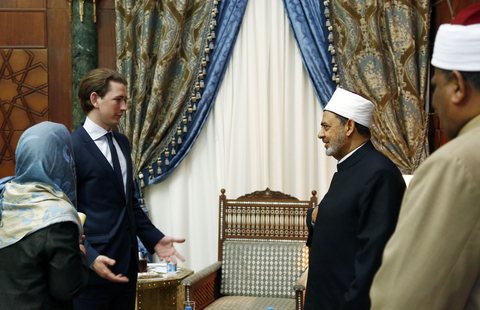
- Wikimedia Commons — Ahmed el-Tayeb and Sebastian Kurz, May 2015, CC BY 2.0 (portrait)
- Wikimedia Commons — BlankMap-Equirectangular.svg, CC0 (base map)
- Timeline primary source checked 2026-09-23; house applications are editorial analysis
.jpg)
